Building Scalable Architecture: Proven Patterns and Best Practices for High-Growth Systems
Building Scalable Architecture: Proven Patterns and Best Practices for High-Growth Systems
When Growth Becomes a Threat Instead of a Victory
At the beginning, everything worked fine.
The product launched quietly. Traffic was predictable. The database never exceeded a few thousand records. Deployments were simple. Logs were rarely checked because nothing ever went wrong.
Then growth arrived.
Not the "steady, controlled growth" described in architecture books — but the kind of growth that comes suddenly, triggered by marketing campaigns, seasonal sales, viral traffic, or enterprise onboarding.
At first, the signs were subtle:
- Pages started loading one or two seconds slower
- Background jobs began to queue up
- Database CPU usage spiked during peak hours
- Support tickets mentioning "slowness" appeared more frequently
The team dismissed them.
"Let's just scale the server." "Add more RAM." "It's probably temporary traffic."
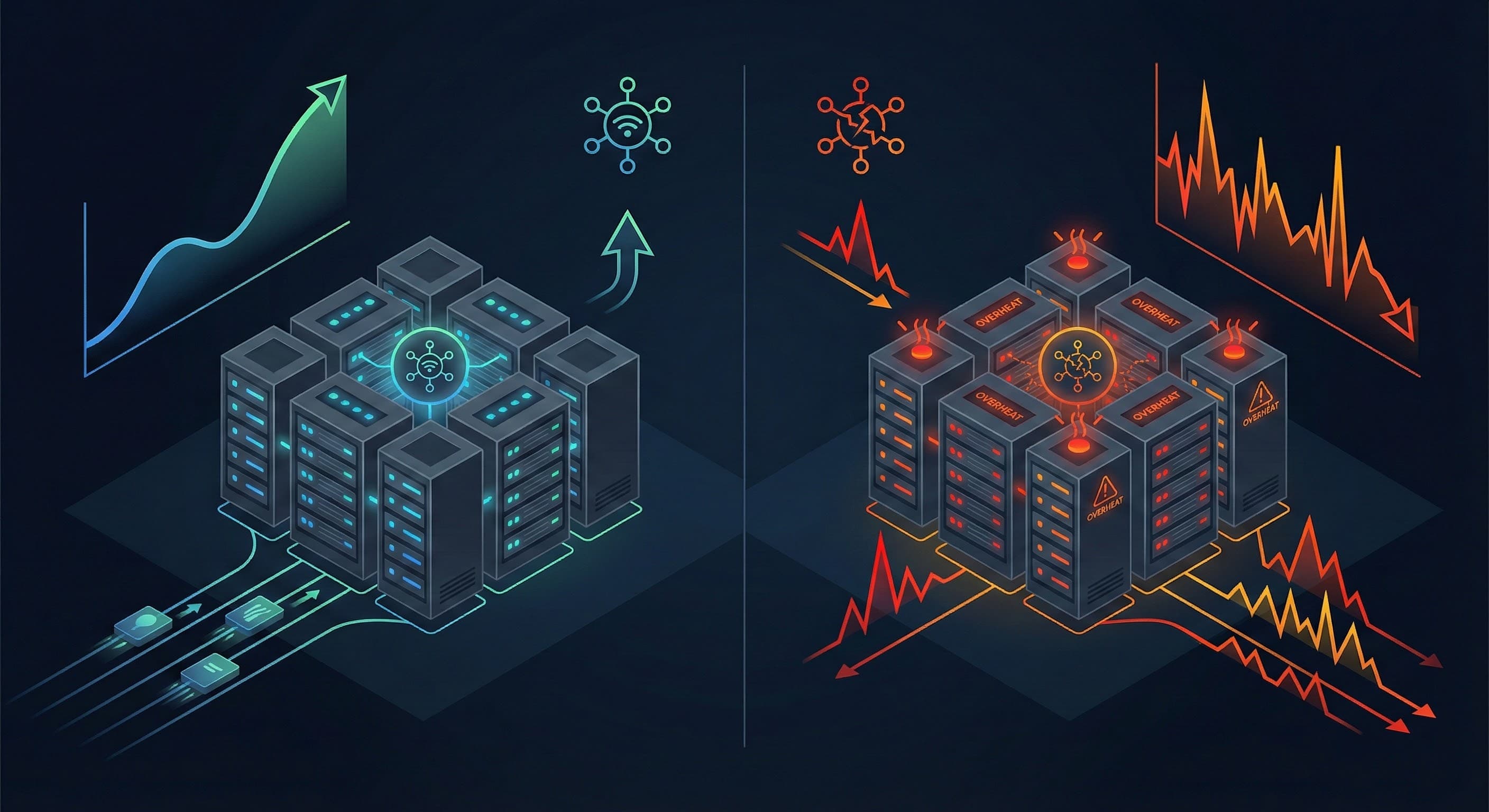
Until one day, the system broke.
Checkout requests timed out. APIs returned 500 errors. Background jobs fell hours behind. And dashboards lit up red — if dashboards even existed.
This is not a rare story. We have seen it repeatedly across SaaS platforms, e-commerce systems, internal enterprise tools, and high-traffic content platforms.
Growth is not the problem. Unprepared architecture is.
This article is written for teams who want to avoid learning this lesson the hard way. Not with buzzwords. Not with abstract diagrams. But with practical architectural patterns, trade-offs, and real-world mistakes that emerge only when systems are pushed beyond their original assumptions.
What Scalability Really Means (Beyond the Textbook Definition)
Scalability is often defined as "the ability of a system to handle increased load by adding resources."
While technically correct, this definition hides the real complexity.
In practice, scalability means:
- Handling traffic spikes without downtime
- Serving more users without linear cost growth
- Supporting new features without destabilizing the system
- Recovering gracefully from partial failures
- Allowing teams to move fast without stepping on each other
A system can scale in one dimension and completely fail in another.
For example:
- A system may scale reads but collapse under writes
- It may handle traffic but fail during deployments
- It may support growth but become impossible to operate
True scalability is multi-dimensional.
Vertical vs Horizontal Scaling: Why the Obvious Choice Often Fails
Vertical Scaling (Scale Up)
Vertical scaling means adding more resources to a single machine:
- More CPU
- More RAM
- Faster disks
Advantages:
- Simple to implement
- Minimal code changes
- Works well in early stages
Hidden Costs:
- Hard limits (you can't scale infinitely)
- Single point of failure
- Increasingly expensive hardware
- Downtime during upgrades
Vertical scaling buys time — not long-term stability.
Horizontal Scaling (Scale Out)
Horizontal scaling means adding more machines and distributing the load.
Advantages:
- Better fault tolerance
- Cost-efficient at scale
- Enables redundancy and high availability
Challenges:
- Requires stateless design
- Introduces network latency
- Demands strong observability
- Makes debugging harder
Most modern systems must eventually move horizontally, but doing so prematurely or incorrectly introduces new failure modes.
The First Real Bottleneck: State
Almost every scalability problem traces back to state:
- Session state
- Application state
- Database state
- Cache state
If state is tied to a single node, scaling becomes impossible.
Stateless Services as a Foundation
Stateless services allow:
- Requests to be handled by any instance
- Easy horizontal scaling
- Safe rolling deployments
State should be externalized:
- Sessions → Redis
- Files → Object storage
- Caches → Distributed cache
- Coordination → Message queues or databases
This principle sounds simple — but violating it is one of the most common reasons systems fail under load.
Architectural Patterns That Enable Growth
Microservices: Power With a Price
Microservices promise:
- Independent deployment
- Team autonomy
- Technology freedom
They also introduce:
- Network latency
- Distributed failures
- Complex observability
- Operational overhead
A hard truth: Microservices do not scale systems — they scale organizations.
For many teams, microservices are introduced too early, increasing complexity without delivering benefits.
When Microservices Make Sense
- Multiple teams working in parallel
- Clear domain boundaries
- Strong DevOps maturity
- Robust monitoring and tracing
When They Don't
- Small teams
- Low traffic
- Unclear product direction
A well-structured modular monolith often outperforms a premature microservices architecture.
Event-Driven Architecture: Decoupling Without Chaos
Event-driven systems communicate through events rather than direct calls.
Benefits:
- Loose coupling
- Async processing
- Natural scalability
Risks:
- Event storms
- Difficult debugging
- Event versioning issues
- Eventual consistency
Without discipline, event-driven systems become distributed spaghetti.
Successful implementations rely on:
- Clear event contracts
- Idempotent consumers
- Dead-letter queues
- Strong monitoring
Caching: The Most Powerful and Dangerous Optimization
Caching can reduce load by orders of magnitude. It can also introduce subtle, catastrophic bugs.
Common Caching Layers
- CDN caching (static assets, APIs)
- Application-level caching
- Database query caching
The Real Challenge: Invalidation
"There are only two hard things in computer science: cache invalidation and naming things."
Incorrect invalidation leads to:
- Stale data
- Inconsistent behavior
- Business logic errors
Effective caching strategies require:
- Clear TTLs
- Explicit invalidation rules
- Versioned cache keys
- Observability into cache hit ratios
Caching should be introduced after measurement, not as a blind optimization.
Database Scaling: Where Most Systems Break
Databases are often the first component to fail under growth.
Read Replicas: The First Step
Read replicas distribute read traffic but:
- Do not solve write bottlenecks
- Introduce replication lag
- Complicate consistency guarantees
Applications must be designed to tolerate eventual consistency.
Sharding: Scalability at Operational Cost
Sharding splits data across multiple databases.
Advantages:
- Linear scalability
- Reduced contention
Costs:
- Complex queries
- Cross-shard transactions
- Operational burden
- Difficult migrations
Sharding is not a silver bullet — it is a long-term commitment.
Choosing the Right Data Store
Different workloads require different databases:
- OLTP → PostgreSQL, MySQL
- Caching → Redis
- Analytics → Columnar databases
- Metrics → Time-series databases
- Relationships → Graph databases
Using one database for everything is convenient — until it isn't.
Load Balancing: More Than Just Traffic Distribution
Load balancers are critical control points.
They:
- Distribute traffic
- Perform health checks
- Terminate TLS
- Enforce rate limits
Poor load balancing strategies lead to:
- Hot spots
- Cascading failures
- Poor latency distribution
Advanced setups include:
- Layer 7 routing
- Canary deployments
- Blue-green releases
Observability: The Difference Between Control and Panic
You cannot scale what you cannot see.
A scalable system requires:
- Metrics (CPU, latency, throughput)
- Logs (structured, centralized)
- Traces (end-to-end visibility)
- Alerts (actionable, not noisy)
Most teams discover observability after outages — when it's already too late.
Real-World Best Practices From High-Growth Systems
- Design for failure — because failure is guaranteed
- Measure before optimizing
- Scale incrementally
- Avoid premature complexity
- Test under realistic load
- Automate everything
- Document architectural decisions
The Hidden Cost of "Working Fine"
Many systems fail not because they were poorly built — but because they were built for yesterday's assumptions.
Traffic changes. Teams grow. Business models evolve.
Architecture must evolve with them.
Final Thoughts: Scalability Is a Continuous Process
Scalable architecture is not a destination.
It is an ongoing discipline of:
- Observation
- Trade-offs
- Iteration
- Learning from failure
The systems that survive growth are not the ones with the most technologies — but the ones with the clearest understanding of their constraints.
At OptyxStack, we have learned this lesson repeatedly, across different systems, workloads, and failure modes.
And the earlier these lessons are applied, the cheaper they are.