The core idea
Pricing is only useful when it maps to a decision. Buy audit when you still need diagnosis. Buy sprint when the diagnosis is strong enough to implement.
Most buyers do not struggle with the number on the proposal. They struggle with a simpler question: "Are we paying to find the real problem, or paying expensive people to guess in production?"
As of April 2, 2026, the current public pricing on this site is: Core Audit at $4k, Deep Audit at $10k, and Optimization Sprint at $42k. The right choice depends less on headcount and more on the next hard decision in front of you: diagnose the mess, de-risk a bigger spend, or ship the fixes.
Context
This article sits in the LLM Audit hub. If you are still figuring out whether you have an audit problem at all, start with Do You Need an LLM Audit?. If you are comparing audit types, read GenAI Audit vs AI System Audit.
1) The short answer
Buy the Core Audit when the team knows something is off, but every meeting turns into the same argument: product thinks it is prompt quality, engineering blames retrieval, finance points at spend, and nobody can say which fix should happen first.
Buy the Deep Audit when the cost of being wrong is no longer small. That usually means multiple workflows, an executive review coming up, or a bigger implementation budget that should not be approved on instinct.
Buy the Optimization Sprint when the diagnosis is already solid and what you need now is shipped changes, tighter controls, and proof that the system actually improved.
Quick fit guide
Choose based on what decision you need to make next
Core Audit
$4k
Best when you need a baseline, a diagnosis, and a clear recommendation on what to fix first.
- Baseline metrics
- Root-cause analysis
- Prioritized roadmap
Deep Audit
$10k
Best when failure modes overlap and you need stronger proof, broader coverage, and a more defensible plan.
- Fuller production baseline
- Deeper failure taxonomy
- ROI roadmap with more evidence
Optimization Sprint
$42k
Best when you already know the workflow is worth saving and need implementation, validation, and shipped improvements.
- Accuracy and reliability fixes
- Production PRs
- Before/after benchmarks
2) Current pricing on this site
Current package pricing in the pricing page is:
- Core Audit: $4k
- Deep Audit: $10k
- Optimization Sprint: $42k
These numbers matter less than the decision each package is supposed to unlock:
- Core Audit: What is broken, how big is the gap, and what should we do first?
- Deep Audit: What is really happening across the system, how confident are we, and what roadmap is worth funding?
- Optimization Sprint: Can we fix the system in production and prove the improvement fast enough to matter?
3) What a good package comparison should make obvious
Buyers often compare the cheapest line item to the most expensive one and assume the difference is just "more hours." That is not the right comparison. A good package comparison should tell you four things immediately:
- what decision the package helps you make
- what concrete artifacts you should receive
- what the package is a bad fit for
- what evidence would justify moving to the next package
| Package | Best next decision | Artifacts you should expect | Bad fit when |
|---|---|---|---|
| Core Audit | Diagnose the dominant constraints and pick the right fix order | Baseline scorecard, root-cause map, prioritized roadmap, stop/continue/escalate recommendation | You already know what to implement and only need execution |
| Deep Audit | Reduce decision risk when several workflows or failure modes interact | Broader baseline, deeper taxonomy, stronger ROI roadmap, more defensible scope for a larger follow-on engagement | You have one narrow workflow and the problem is already obvious |
| Optimization Sprint | Ship fixes in production and validate before/after impact | Implementation plan, production changes, validation benchmarks, regression controls | You are still arguing about root cause or whether the workflow is worth saving |
4) What the Core Audit buys you
The $4k Core Audit is usually the right starting point when the team has enough pain to care, but not enough clarity to spend confidently. Common signs:
- users report wrong answers, but demos still look fine
- cost is rising, but nobody can attribute it cleanly
- latency feels bad, but the bottleneck is unclear
- prompt tweaks keep happening without a stable baseline
At this level, the job is not to produce a thick deck. The job is to leave with a baseline you trust, a shortlist of real causes, and a sane answer to "what do we do first on Monday?"
Minimum outcomes you should expect
- a baseline on quality, cost, latency, and risk for the workflow in scope
- a root-cause map that separates retrieval, prompt/model, tool, and release-control problems
- a prioritized roadmap with quick wins, deeper fixes, and explicit tradeoffs
- a recommendation on whether to stop, continue, or escalate into implementation
If a Core Audit does not make the next decision easier, it was too shallow.
Representative artifact stack
- Baseline scorecard: quality, cost per successful task, latency, and release risk for the workflow in scope
- Failure map: what is wrong, where it happens, and how often it appears
- Fix order memo: what to change first, what to ignore for now, and why
- Escalation rule: whether to stop at diagnosis, expand to a deeper audit, or move into implementation
5) What the Deep Audit adds
The $10k Deep Audit is not "Core Audit plus extra polish." It is for situations where a shallow answer would be actively expensive.
That usually means one or more of these:
- multiple workflows or buyer-critical journeys are in scope
- quality, cost, and release risk are all entangled
- leadership needs stronger evidence before approving a larger sprint or retainer
- the system already has real production volume and bad fixes are expensive
What you are paying for at the Deep Audit level
- broader and more defensible baseline coverage
- deeper failure taxonomy by cohort, use case, or workflow slice
- clearer sequencing for what to fix now, later, or not at all
- better decision support for executive review, budget approval, or sprint scoping
Deep Audit makes sense when low-confidence recommendations would cost more than the extra audit fee.
Representative buying pattern
A support copilot is wrong often enough to annoy users, expensive enough that finance is asking for a story, and fragile enough that every prompt or KB change makes the team nervous. That is usually too much uncertainty for a sprint-first decision. A deeper audit is cheaper than four weeks of implementation against the wrong diagnosis.
6) When an Optimization Sprint is the right move
The $42k Optimization Sprint is for implementation. This is the point where the conversation should shift from "what is happening?" to "what are we changing first?"
Good reasons to move into a sprint:
- the workflow is already important enough that saving it matters commercially
- the dominant constraints are understood well enough to act on
- you need production PRs, eval changes, routing fixes, observability, or release gates
- you care about before/after proof, not just recommendations
A sprint should not start with vague suspicion. It should start with a target condition, a measured gap, and a fix order that somebody can defend in front of product, engineering, and finance.
7) Who should not buy each option
Good pricing content should disqualify bad-fit buyers early. If a page makes every package sound right for everyone, it reads like marketing, not operating experience.
- Do not buy Core Audit if you already trust the diagnosis and only need implementation capacity.
- Do not buy Deep Audit if the workflow is small, low stakes, and the dominant constraint is already obvious.
- Do not buy Optimization Sprint if there is no stable owner, no meaningful baseline, or no internal agreement that the workflow is worth saving.
- Do not buy any of them yet if you are still pre-use-case and do not have a real production or near-production workflow to evaluate.
8) The most common buying mistake
The most common mistake is buying implementation before diagnosis.
Teams feel pressure to "just fix it," so they pay sprint-level rates while still debating whether the problem is retrieval, context construction, tool loops, model routing, or missing release controls. That is how expensive weeks disappear. The team stays busy, but nobody can explain cleanly why quality moved, why cost did not move, or why the next release might break again.
If the root cause is still disputed, start with an audit. If the root cause is already clear and the opportunity cost of delay is high, move into a sprint.
A stronger buying heuristic
If the team still debates where the failure lives, buy diagnosis. If the team agrees on the failure and debates how fast to fix it, buy implementation.
That distinction sounds obvious. In practice, it is where a lot of money gets wasted.
9) How to choose in 5 minutes
Use this shortcut:
- Choose Core Audit if your question is: "What is actually broken, and what should we do first?"
- Choose Deep Audit if your question is: "What is the defensible plan across multiple risks, and how strong is the evidence?"
- Choose Optimization Sprint if your question is: "Can we ship the fixes now and prove the improvement?"
A simple decision rule
If the next decision is diagnosis, buy audit. If the next decision is implementation, buy sprint. Most teams get into trouble by paying for implementation while still missing a trustworthy baseline.
10) Questions to ask any vendor before you buy
Whether you work with us or someone else, ask these questions before you sign anything:
- What concrete artifacts will I receive at the end?
- How will you baseline quality, cost, latency, and release risk?
- How do you separate retrieval, model, tool, and governance failures?
- How will you decide what not to fix?
- What evidence would justify moving from audit to sprint?
- How do you prove before/after impact if implementation happens next?
If the answers stay vague, the scope is vague. That usually means you are about to pay for optimism.
One more filter before you buy
Ask the vendor to explain what they expect to say no to. If every package sounds universally useful, the scope boundary is probably weak. Strong offers are specific about what they are for, what they are not for, and what would make them tell you to buy something smaller first.
11) Next steps
Want the shortest path to the right package?
If the team still needs a hard diagnosis, start with the audit. If the workflow is already worth saving and the problem is clear enough, scope the sprint. If you want to see the package structure side by side, review pricing.
FAQ
Questions readers usually ask next
Is the Core Audit enough for most teams?
Yes, if your immediate need is to baseline quality, cost, and latency, identify the dominant failure modes, and decide what to fix first. The $4k Core Audit is the right entry point when the main problem is uncertainty, not implementation bandwidth.
When is the Deep Audit worth the extra money?
The $10k Deep Audit is worth it when you have multiple workflows, higher stakes, more buyer scrutiny, or several failure modes interacting at once. It buys more evidence, a fuller taxonomy, and a stronger decision basis before a larger implementation spend.
Why not skip straight to the Optimization Sprint?
Go straight to the $42k Optimization Sprint only if the root causes are already clear, the workflow is worth saving, and you are confident the main constraint is execution. If the team is still arguing about where the problem lives, paying for implementation first usually burns time and budget.
What should an audit deliver besides slides?
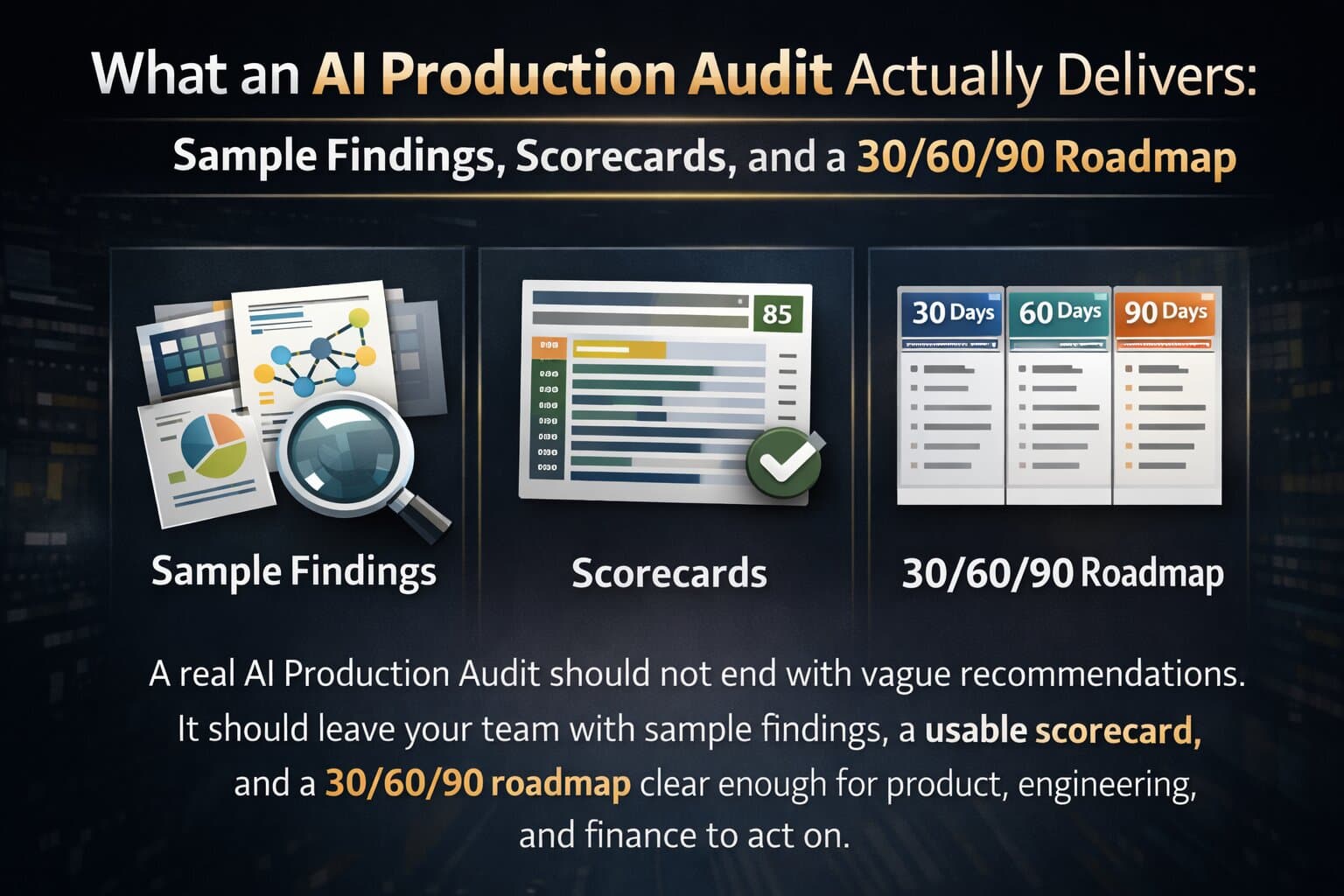
A real audit should leave you with a baseline scorecard, a failure taxonomy, a root-cause map, a prioritized roadmap, and a clear recommendation on what not to do. If you only receive observations and generic suggestions, you did not buy an audit. You bought advice.
Can an audit still help if we already have dashboards and prompt logs?
Yes. Instrumentation alone does not tell you fix order, decision confidence, or ROI. An audit turns scattered evidence into a diagnosis, a scope boundary, and a concrete sequence of changes tied to business outcomes.
Who should not buy an audit yet?
Do not buy an audit yet if there is no meaningful production workflow, no real buyer-critical use case, or no internal owner who can act on findings. In those situations, you usually need product clarification or a smaller diagnostic step before a formal audit creates much value.
Choose Core Audit if...
The team sees the symptoms, but still lacks a shared baseline, a root-cause map, and a credible fix order.
Do not buy sprint if...
The workflow is commercially important, but the failure modes are still disputed. Paying implementation rates before diagnosis is where waste usually starts.
Want a fast fit recommendation?
Tell us what is hurting most right now: wrong answers, cost drift, regressions, or latency. We will tell you whether to start with a Core Audit, Deep Audit, or Sprint in the AI Production Audit intake.
Last updated
April 2, 2026