The core idea
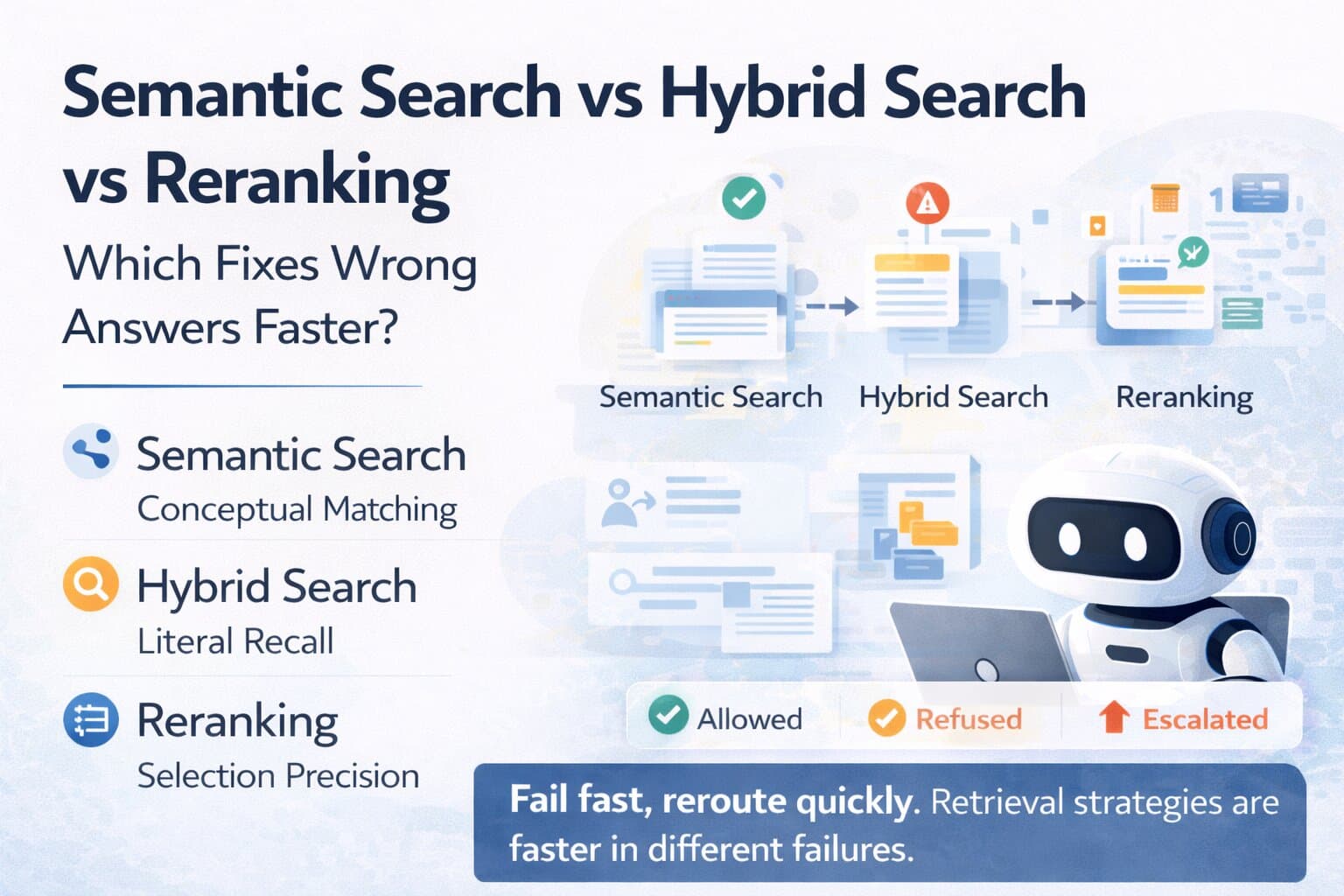
Hybrid retrieval raises recall by combining lexical precision (BM25) with semantic coverage (vectors). Fusion (RRF) prevents score-scale headaches, and reranking turns wide recall into high-precision evidence for grounded answers.
A production-grade hybrid retrieval playbook: when vector-only search fails on exact tokens, IDs, and constraints—and how to fix it with BM25 + fusion + reranking.
Dense embeddings excel at semantic similarity but underperform on exact-match recall: rare tokens, error codes, IDs, version strings, legal clauses, negation, and anything where literal precision matters. For enterprise RAG systems where retrieval misses drive wrong answers and user distrust, a hybrid stack (BM25 + vectors) with fusion and reranking is the most reliable path to measurable recall gains—without blowing up latency or cost.
Context
Part of the RAG Reliability hub: RAG Reliability Hub. See also: Why RAG Still Hallucinates When Retrieval Looks Fine, RAG Recall vs Precision Diagnostic, RAG Optimization Service, Case Study: Low Recall Fix, RAG Wrong Answers, AI Optimization, AI System Audit.
1) The problem: why vector-only retrieval misses obvious answers
Vectors fail most often when the user’s intent depends on literal tokens, not “meaning.” Common failure patterns:
A) Rare tokens & exact strings
- Ticket IDs (INC-10492), SKUs (A1B-9X), error codes (EPIPE, ORA-00942)
- Proper nouns (customer names, internal system names, acronyms)
- URLs and endpoints (/v2/invoices/{id}), CLI flags (--force)
Dense similarity often compresses away these details.
B) Keyword constraints and negation
“not supported”, “except”, “only if”. Dense similarity can retrieve a doc that’s “about refunds” but misses the “no refunds after 14 days” clause.
C) Multi-entity queries
“Compare Plan A vs Plan B for EU customers with SSO.” Vectors may retrieve “Plan A overview” but not the comparison or EU/SSO constraints.
D) Domain jargon and formatting
Legal language, tables, configuration blocks, changelogs. The answer is often a single line in a long doc; lexical match finds it faster.
BM25 (lexical search) excels precisely where vectors stumble: exact tokens, rare words, and phrase constraints.
2) The production pattern: retrieve wide, rerank smart, answer grounded
A reliable production pipeline is usually three stages:
- Candidate generation (wide recall): BM25 topN + Vector topN
- Fusion: merge + dedupe, combine ranks (RRF is a great default)
- Reranking (precision): cross-encoder (or LLM rerank as tie-breaker)
Why it works: BM25 prevents “needle-in-haystack” misses, vectors cover paraphrases, and reranking fixes the false positives from both.
# Hybrid Retrieval + Reranking (production pattern)

def retrieve(query):
    q = normalize(query)

    # 1) Candidate generation (wide recall)
    bm25 = bm25_search(q, topN_lex=100)
    dense = vector_search(q, topN_dense=100)

    # 2) Fusion (merge + dedupe, default = RRF)
    fused = rrf_fuse([bm25.ids, dense.ids], k=60)
    topM = take_unique([doc_id for doc_id, _ in fused], M=120)

    # 3) Reranking (precision)
    scored = rerank_cross_encoder(query=q, candidates=topM)  # (doc_id, score)
    topK = [doc for doc, _score in sorted(scored, key=lambda x: x[1], reverse=True)[:10]]

    # 4) Context build + grounded answer
    chunks = fetch_chunks(topK)
    return chunks  # with citations + metadata
Latency and cost ballpark (typical production)
Reference ranges for planning and capacity. Actuals depend on index size, hardware, and reranker choice.
| Stage | Typical p50 | Typical p95 | Cost note |
|---|---|---|---|
| BM25 (topN=100) | 10–25 ms | 20–50 ms | Low (index lookup) |
| Dense / vector (topN=100) | 15–40 ms | 30–80 ms | Embedding + ANN search |
| Fusion (RRF) | <5 ms | <10 ms | Negligible |
| Rerank (cross-encoder, M=120) | 30–80 ms | 60–150 ms | Dominant cost; batch when possible |
| Total retrieval | 60–150 ms | 120–280 ms | Reranker is usually the bottleneck |
Worked example: ORA-00942 on v2 invoices
Query: How do I fix ORA-00942 on v2 invoices?
- Dense-only failure: retrieves generic invoice migration docs and database troubleshooting pages, but misses the one page that literally contains ORA-00942.
- BM25 rescue: exact match on ORA-00942 and v2 surfaces the troubleshooting page immediately.
- Fusion benefit: the generic invoice docs still stay in the candidate set, so paraphrase coverage is preserved.
- Rerank benefit: the page that contains ORA-00942, v2, and invoices together moves above generic DB help pages.
This is the core hybrid pattern: lexical search rescues literal recall, dense retrieval keeps semantic breadth, reranking restores precision.
3) Query pre-processing: normalization and expansion
Before retrieval, query pre-processing often yields quick recall wins. Two levers matter most:
Normalization (always)
Lowercase, trim whitespace, collapse repeated punctuation. Preserve literals: IDs, error codes, version strings, paths. Do not stem or aggressively tokenize these—BM25 and dense retrieval both need them intact.
Query expansion (when recall is low)
Add synonyms, acronym expansions, or entity aliases from a small curated dictionary. Example: ORA-00942 → also search table or view does not exist. Use sparingly: over-expansion adds noise. Prefer expansion for known high-value entities (error codes, product names, internal terms).
Query rewriting (advanced)
For conversational or vague queries, a lightweight LLM can rewrite to a more retrieval-friendly form. Useful when users ask in natural language but docs use technical phrasing. Add latency and cost—apply only when baseline recall is insufficient.
4) Hybrid retrieval architectures you can actually ship
Option 1: Parallel BM25 + vector (most common)
Best for: general RAG, docs + tickets + FAQs
- BM25(query) → topN_lex
- Vector(query) → topN_dense
- Fuse → topM
- Rerank topM → topK
Typical values: N_lex=50–200, N_dense=50–200, M=100–300, K=8–20 passages.
Option 2: Lexical-first gating (when exact tokens matter a lot)
Best for: support systems with codes/IDs, engineering docs, API errors
If the query contains strong lexical signals (regex match for IDs/codes), boost BM25 weight or do BM25-only candidate gen. Otherwise run parallel hybrid.
Option 3: Dense-first for natural language, lexical rescue on low confidence
Best for: consumer assistants where most queries are plain English
Run dense first. If overlap with user keywords is low or rerank confidence is low, add BM25 rescue candidates and rerank again.
Quick decision matrix
| Situation | Recommended pattern | Why |
|---|---|---|
| Docs contain IDs, error codes, versions, flags | Lexical-first gating | Exact tokens are first-class relevance signals |
| Mixed support/docs corpus with both keywords and paraphrases | Parallel BM25 + dense | Safest default when cohorts are heterogeneous |
| Mostly plain-English assistant with tight latency budget | Dense-first with lexical rescue | Keeps average latency low while rescuing hard queries |
5) Fusion strategies: merge BM25 + vectors without guessing
A) Reciprocal Rank Fusion (RRF) — recommended default
RRF is robust because it doesn’t require score calibration between BM25 and dense systems. Common k: 60.
from collections import defaultdict

def rrf_fuse(rankings, k=60, limit=None):
    """
    rankings: list of lists of doc_ids ordered best->worst
              e.g. [bm25_top, dense_top]
    k: RRF constant (60 is a strong default)
    limit: optionally truncate each ranking list before fusion
    """
    scores = defaultdict(float)
    for r in rankings:
        rr = r[:limit] if limit else r
        for i, doc_id in enumerate(rr, start=1):  # rank starts at 1
            scores[doc_id] += 1.0 / (k + i)

    # sort by fused score descending
    return sorted(scores.items(), key=lambda x: x[1], reverse=True)

# Example:
# fused = rrf_fuse([bm25_doc_ids, dense_doc_ids], k=60)
# topM = [doc for doc, _score in fused[:200]]
B) Weighted score blending (requires calibration)
Normalize per-retriever scores (min-max or z-score), then blend: score = α·norm_bm25 + (1−α)·norm_dense. Use this when you have stable distributions and can tune α with offline eval.
C) OR union + rerank
The simplest: union candidates and let reranker decide. Works well if your reranker is strong and topM is bounded.
6) Reranking: turning recall into precision
Hybrid retrieval improves recall, but it will pull in more junk. Reranking is the precision filter.
Reranker choices
- Cross-encoder reranker — best general option, high quality, moderate cost
- ColBERT-style late interaction — fast at scale, strong quality, more engineering
- LLM reranking — nuanced relevance, expensive; use sparingly (small M) or as tie-breaker
Practical reranking defaults
- Rerank topM = 100–150 (start at 120)
- Keep topK = 8–12 passages for generation
- Prefer shorter, well-formed passages (chunking matters)
Rerank rubric (what “relevant” means)
- Answers the question directly (not just topic-related)
- Matches constraints (region, version, plan, exceptions)
- Contains required entities (IDs, feature names, endpoints)
- Does not conflict with user constraints (negation matters)
7) BM25 tuning that actually moves recall
BM25 isn’t “set and forget.” A few knobs dramatically change performance:
A) Field boosts (huge win)
If you have structured docs: boost title high, headings medium, body baseline, tags/keywords medium. This makes exact matches in titles/headings rank much higher.
B) Analyzer & tokenization (make it match your domain)
Preserve tokens like v1.2.3, INC-1234, S3://…, endpoints, and flags. Consider ngrams for partial match (careful—can add noise).
PUT docs_v1
{
  "settings": {
    "analysis": {
      "tokenizer": {
        "path_tokenizer": {
          "type": "pattern",
          "pattern": "[\\s\\t\\n]+"
        }
      },
      "filter": {
        "edge_2_20": { "type": "edge_ngram", "min_gram": 2, "max_gram": 20 }
      },
      "analyzer": {
        "domain_lexical": {
          "type": "custom",
          "tokenizer": "standard",
          "filter": ["lowercase"]
        },
        "preserve_ids": {
          "type": "custom",
          "tokenizer": "path_tokenizer",
          "filter": ["lowercase"]
        },
        "partial_match": {
          "type": "custom",
          "tokenizer": "standard",
          "filter": ["lowercase", "edge_2_20"]
        }
      }
    }
  },
  "mappings": {
    "properties": {
      "doc_id": { "type": "keyword" },
      "title":  { "type": "text", "analyzer": "domain_lexical" },
      "headings": { "type": "text", "analyzer": "domain_lexical" },
      "body":   { "type": "text", "analyzer": "domain_lexical" },
      "entities": { "type": "text", "analyzer": "preserve_ids" },
      "path":   { "type": "text", "analyzer": "preserve_ids" },
      "tags":   { "type": "keyword" },
      "locale": { "type": "keyword" },
      "version": { "type": "keyword" }
    }
  }
}

# Query-time boosts example:
# - title boosted high, headings medium, body baseline
# - entities/path fields catch IDs, versions, endpoints, flags
# {
#   "query": {
#     "bool": {
#       "should": [
#         { "match": { "title":    { "query": "<q>", "boost": 4.0 } } },
#         { "match": { "headings": { "query": "<q>", "boost": 2.0 } } },
#         { "match": { "body":     { "query": "<q>", "boost": 1.0 } } },
#         { "match": { "entities": { "query": "<q>", "boost": 3.0 } } },
#         { "match": { "path":     { "query": "<q>", "boost": 3.0 } } }
#       ]
#     }
#   }
# }
C) BM25 parameters (k1, b)
Defaults are often fine, but documentation corpora can be tricky: long docs can be over-penalized. Adjust b carefully and validate on a golden set.
D) Phrase queries as a boost
If the query contains quoted strings or detected IDs/codes, add a phrase-boost clause. This is a quick recall win for exact tokens.
8) Dense retrieval tuning: don’t blame the embedder too early
Before swapping embeddings, check the pipeline basics:
- Chunk sizes are sane (see below)
- Metadata filters are correct (version, product, locale)
- You embed the right text (title + headings + body)
- You’re not mixing wildly different domains in one index (policies + code + marketing)
- Your ANN/index parameters are not trading too much recall for speed
When vectors fail, it’s often pipeline design—not the embedding model.
Dense retrieval checks that catch real failures:
- Embedding input format: for docs, include title + section path + body, not body alone
- Query normalization: remove noise, but preserve literals like IDs, versions, and negation
- ANN tuning: verify candidate recall at your current HNSW/IVF settings before declaring the embedder weak
- Index boundaries: separate corpora when semantics differ too much (marketing copy vs policy docs vs code)
- Language/domain mismatch: multilingual or jargon-heavy corpora often need different embedding and routing choices
9) Chunking + hybrid: the hidden multiplier
Hybrid works best when chunks are: heading-aware, not too large (dilutes BM25 and dense), not too small (loses context and confuses reranker).
Practical starting points:
- 300–800 tokens per chunk (docs)
- Preserve headings as prefix
- Keep tables/code blocks as dedicated chunks
- Add “section path” metadata: Doc > H1 > H2
10) Evaluation: prove hybrid is better (and keep it better)
If you can’t measure retrieval, you’ll ship regressions. Minimum offline metrics:
- Recall@K (did we retrieve an answer-containing chunk?)
- MRR (how high is the first relevant chunk?)
- nDCG@K (ranking quality)
- Coverage (% queries with any relevant chunk in topK)
For hybrid, track recall@K for: BM25-only → dense-only → fused → fused+rerank (final). You want: hybrid improves recall and rerank improves precision without killing recall.
Be explicit about what you are measuring at each stage: candidate generation is usually a doc-level recall question, while reranking and final context selection are chunk-level ranking questions. Mixing those levels hides regressions.
Build a small golden set
Start with 50–200 queries pulled from logs with known-good references: query, expected doc/passage IDs, and constraints (version/region/plan). Run it for every retrieval change.
11) Observability: the debug view you must instrument
Hybrid makes retrieval more complex. Instrument it or you’ll guess. Log per request: BM25 topN, dense topN, fusion method + overlap stats, rerank topK + scores, final context IDs, stage latencies.
{
  "request_id": "req_abc123",
  "query_raw": "How to fix ORA-00942 on v2 invoices?",
  "query_normalized": "fix ora-00942 v2 invoices",
  "signals": {
    "contains_id_or_code": true,
    "contains_version": true,
    "contains_negation": false
  },
  "bm25": {
    "topN": 100,
    "doc_ids": ["doc_17", "doc_91", "doc_03"],
    "ranks": [1, 2, 3],
    "latency_ms": 18
  },
  "dense": {
    "topN": 100,
    "doc_ids": ["doc_44", "doc_03", "doc_88"],
    "ranks": [1, 2, 3],
    "latency_ms": 26
  },
  "fusion": {
    "method": "rrf",
    "rrf_k": 60,
    "overlap_size": 12,
    "topM": 120,
    "doc_ids": ["doc_03", "doc_17", "doc_44"]
  },
  "rerank": {
    "type": "cross_encoder",
    "topK": 10,
    "doc_ids": ["doc_03", "doc_17", "doc_22"],
    "scores": [0.91, 0.84, 0.79],
    "latency_ms": 42,
    "rerank_gain_top1_changed": true
  },
  "context_used": {
    "doc_ids": ["doc_03", "doc_17"],
    "chunk_ids": ["doc_03#h2-4", "doc_17#h3-2"],
    "total_context_tokens": 2380
  },
  "outcomes": {
    "answer_grounded": true,
    "citation_clicked": false,
    "user_reask_within_2_turns": false
  },
  "stage_latency_ms": {
    "bm25": 18,
    "dense": 26,
    "fusion": 2,
    "rerank": 42,
    "total_retrieval": 88
  }
}
Key dashboards:
- Retrieval proxy: % queries where topK contains any clicked/accepted citation (useful in production, but not a substitute for labeled recall)
- Overlap: |BM25 ∩ dense| (low overlap can signal query mismatch or analyzer issues)
- Rerank gain: how often reranker changes top1/top3
- Tail latency: p95/p99 per stage (bm25/vector/rerank)
12) Failure modes (and the fix order)
Failure: “Still can’t find the doc”
- Add BM25 field boosts + token-preserving analyzer
- Increase N_lex and N_dense slightly (watch tail latency)
- Add phrase boosts for detected IDs/codes
- Improve chunking (heading-aware)
- Only then consider embedding model changes
Failure: “Finds docs but picks the wrong one”
- Add/strengthen reranker
- Improve metadata filters (version/product/locale)
- Add constraint extraction (EU, v2, enterprise plan)
- Encode must-have entities in rerank rubric
Failure: “Latency too high”
- Reduce rerank topM (e.g., 200 → 100–120)
- Use cheaper reranker or two-stage rerank (fast → small LLM tie-break)
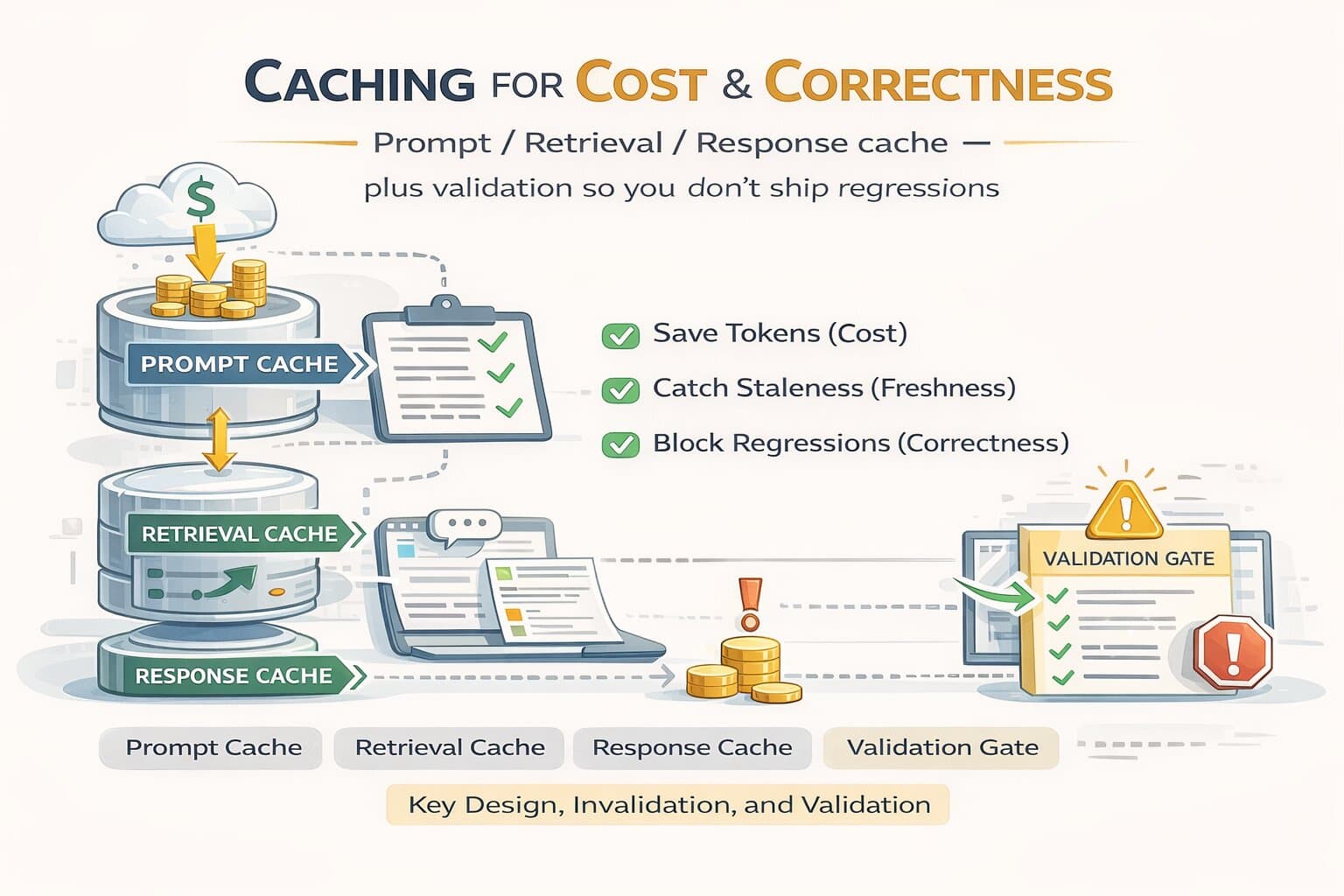
- Cache retrieval by normalized query (TTL + invalidation)
- Optimize search infra (BM25 index + vector index)
13) A practical default configuration (good starting point)
# Practical defaults (boring is good in production)

candidate_generation:
  bm25_topN_lex: 100
  dense_topN_dense: 100

fusion:
  method: "rrf"
  rrf_k: 60

rerank:
  model: "cross_encoder"   # or "colbert", "llm_tiebreak"
  topM: 120
  topK: 10

chunking:
  target_tokens: [500, 800]
  heading_prefix: true
  keep_code_blocks_intact: true
  keep_tables_intact: true
  section_path_metadata: true  # Doc > H1 > H2

gates:
  must_not_reduce_recall_at_10: true
  max_p95_retrieval_latency_increase_pct: 15
This is intentionally boring. Boring is good in production. Make changes behind eval gates and measure tail latency.
14) Shipping checklist (copy/paste into your PR)
Retrieval
- BM25 index with field boosts (title/headings/body)
- Tokenization preserves IDs/versions/paths
- Dense index built from structured chunks + headings
- Hybrid fusion (RRF default) + dedupe
Reranking
- Rerank topM merged candidates
- Keep topK for generation with citations
Evaluation
- Golden set + Recall@K/MRR/nDCG tracked
- Baseline vs candidate diff produced
- Regression gate defined (recall + latency thresholds)
Observability
- Stage latency metrics (bm25/vector/fusion/rerank)
- Candidate lists logged (sampled)
- Dashboard for overlap + rerank gain + tail latency
15) Closing: why hybrid + rerank is the highest ROI retrieval upgrade
If you’re currently vector-only, adding BM25 + fusion + rerank is usually the fastest way to:
- Fix “obvious doc not retrieved” failures
- Improve recall on rare tokens and constraints
- Reduce hallucinations caused by missing evidence
- Create a measurable retrieval system you can tune and govern
See our case study on fixing low recall for a real-world example: hybrid retrieval, reranking, and query rewriting improved answer accuracy by 18–30 points without changing the LLM.
Want a concrete implementation spec?
Tell us your stack (OpenSearch/Elastic vs Postgres+pgvector vs vector DB) and corpus types (policies, product docs, tickets, PDFs). We can turn this playbook into an implementation spec (APIs + config + eval harness outputs) and ship it behind regression gates via{" "} AI Optimization {" "} or validate it end-to-end in an{" "} AI System Audit .
FAQ
Questions readers usually ask next
When should I use hybrid search instead of vector-only?
Use hybrid when your corpus includes rare tokens and exact strings (IDs, error codes, version numbers, endpoints, SKUs), policy/legal clauses with negation/constraints, or multi-entity queries that require literal matching. Hybrid boosts recall; reranking restores precision.
What fusion method should I start with?
Start with Reciprocal Rank Fusion (RRF). It’s robust because it doesn’t require score calibration between BM25 and dense retrieval. Union + rerank is also a strong baseline if M is small and your reranker is reliable.
How do I keep hybrid from increasing latency too much?
Control the rerank set size (topM), cache retrieval by normalized query, and log stage latency. If tail latency grows, reduce M (e.g., 200→100), use a cheaper reranker or two-stage rerank, and optimize your search infra (BM25 index + vector index).
Is RRF k=60 always the best choice?
k=60 is a robust default that works well across many corpora. Lower k (e.g., 30) gives more weight to top ranks; higher k (e.g., 100) flattens the contribution of lower ranks. Tune only when you have a golden set and observe rank-order sensitivity. Most teams ship k=60 and focus on other levers first.
When should I use ColBERT instead of a cross-encoder reranker?
ColBERT-style late interaction is faster at scale because it precomputes token-level representations and scores at query time. Use it when you rerank large M (200+) or have strict latency budgets. Cross-encoders typically yield higher precision for smaller M (50–150). Start with cross-encoder; move to ColBERT if rerank latency dominates.
Want a stack-specific spec + gates?
Tell us your index stack and corpora. We’ll produce a concrete implementation plan (APIs + configs + golden set + dashboards) and ship it via AI Optimization or validate end-to-end in an AI System Audit.
Last updated
March 7, 2026