The core idea
The fastest fix is not the fanciest retrieval stack. It is the first change that matches the actual failing layer in your traces and evals.
Teams debugging wrong answers in RAG often ask the wrong comparison question. They ask which retrieval technique is "best." The better question is: which lever fixes this failure layer fastest?
Semantic search, hybrid search, and reranking are not interchangeable. They operate at different points in the retrieval pipeline and solve different kinds of misses. If you apply the wrong one first, you add cost and complexity without moving answer quality much.
This article is a decision guide for that choice: when semantic search is enough, when hybrid search is the fastest recall fix, and when reranking is the fastest precision fix.
Context
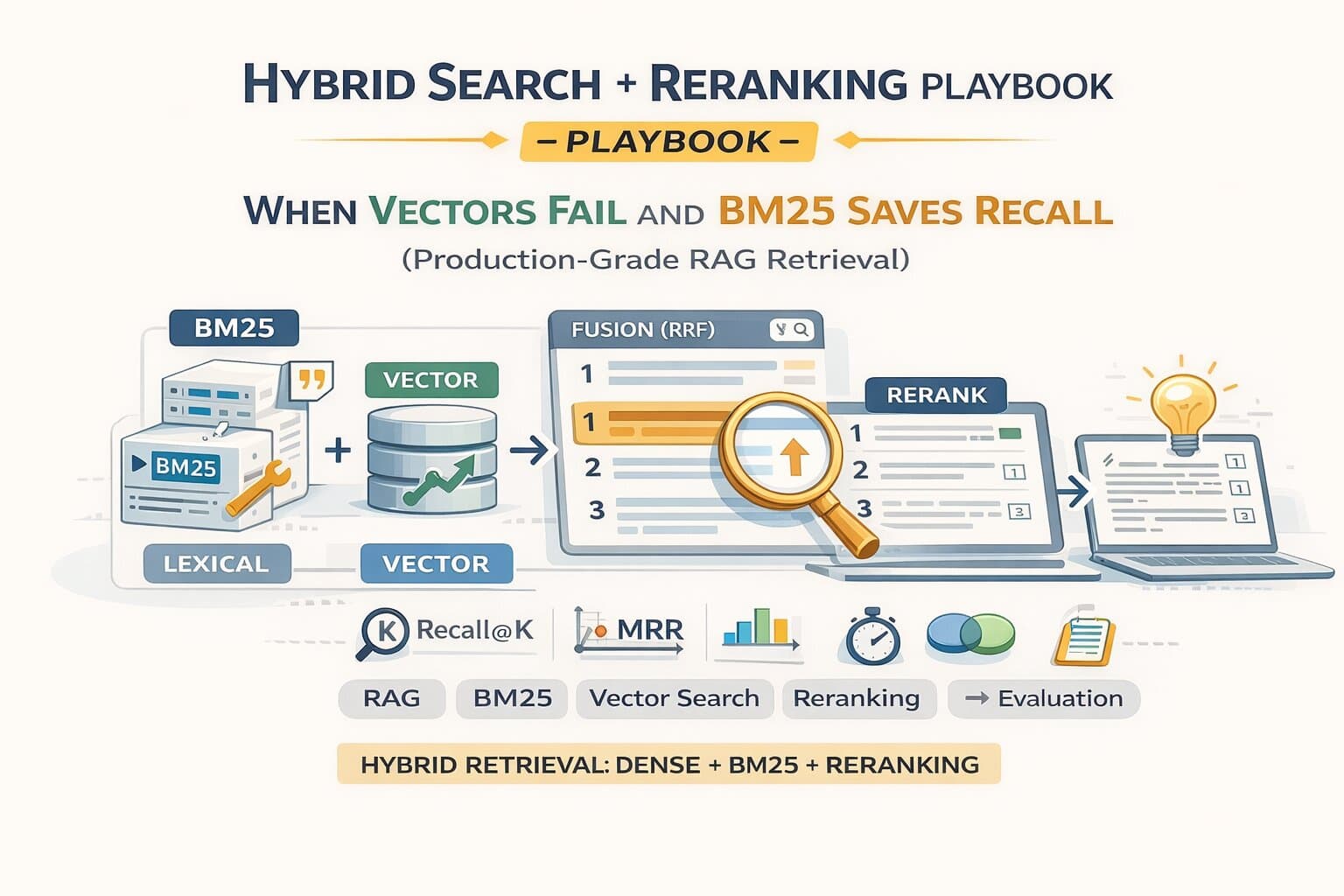
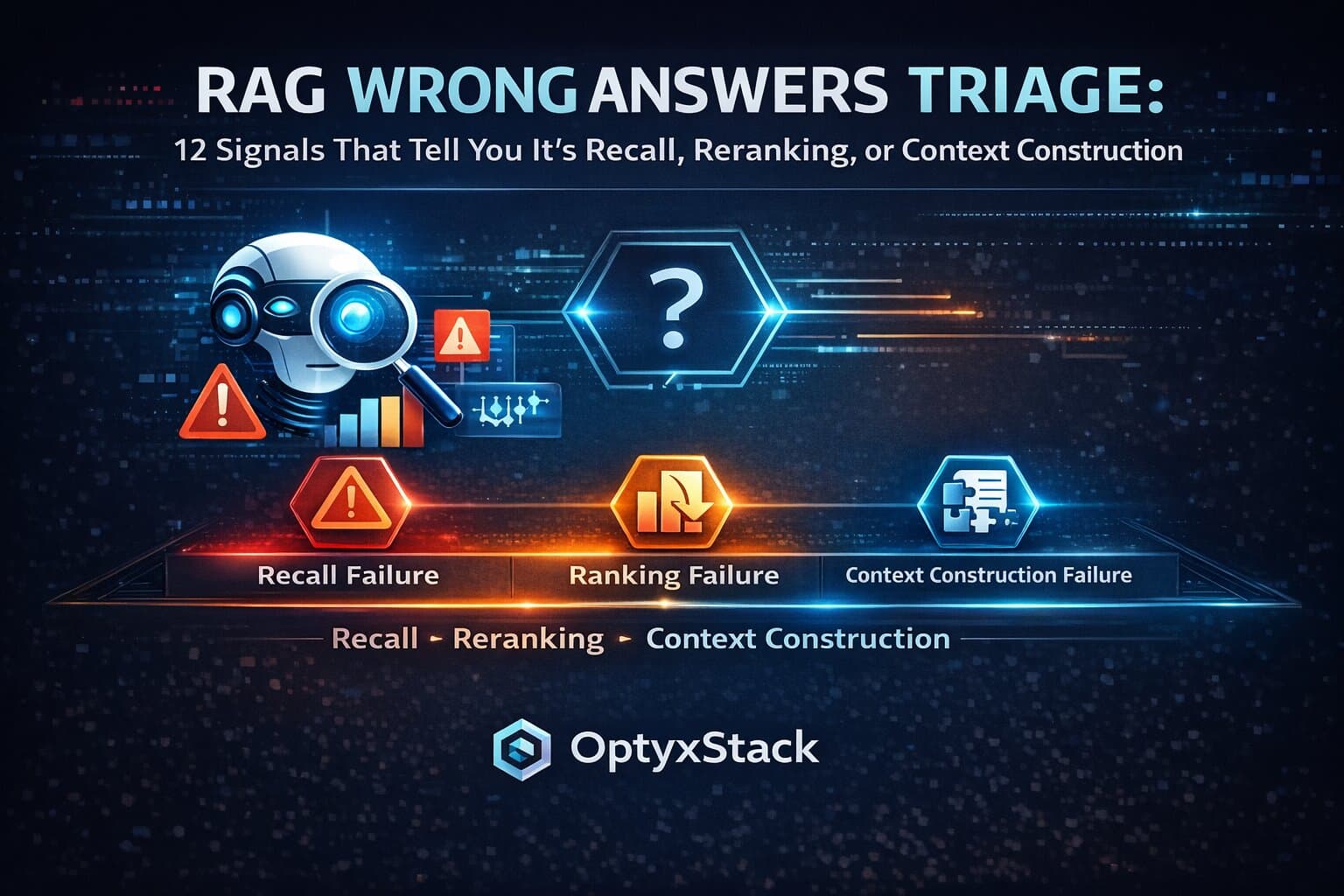
Part of the RAG Reliability hub. Related: Hybrid Search + Reranking Playbook, RAG Recall vs Precision, RAG Chunking Strategy, RAG Wrong Answers Triage, and Why RAG Still Hallucinates.
The short answer
If the wrong answer comes from conceptual mismatch, semantic search improvements can help fastest. If it comes from literal recall failure, hybrid search usually helps fastest. If the right source is already in candidates but lost in ranking or final-context assembly, reranking usually helps fastest.
- Semantic search: best when users and docs say the same thing with different words
- Hybrid search: best when exact tokens, IDs, codes, versions, and constraints matter
- Reranking: best when candidates are broad enough but the top results are noisy or ordered badly
The mistake is adding all three at once. You lose interpretability, increase latency, and make it harder to prove which change actually fixed wrong answers.
What each lever actually changes
These techniques act on different layers of the retrieval pipeline:
- Semantic search changes candidate generation based on meaning
- Hybrid search changes candidate generation by combining lexical and semantic retrieval
- Reranking changes the order of already-retrieved candidates
That distinction matters because wrong answers usually begin as either a candidate recall failure or a selection precision failure. Only one of those is a reranking problem.
Important
Reranking cannot rescue a document that never entered the candidate set. If the right source is absent from top-50, your first fix is not reranking.
Semantic search: fastest when the gap is conceptual
Semantic search is strongest when the user phrasing and the source phrasing differ, but the meaning is still aligned. Think support questions, help-center articles, internal wiki pages, or FAQs where users paraphrase freely.
Semantic search is the fastest fix when:
- queries are natural language paraphrases of the source text
- the corpus is mostly prose, not literals, IDs, or rule-heavy text
- vector retrieval misses because the current embedder or chunking strategy is semantically weak
- exact-match signals are not the main problem in traces
Semantic search is usually the wrong first fix when:
- queries include error codes, version strings, SKUs, endpoints, or plan names
- policy answers hinge on negation, thresholds, or exception clauses
- the right source already appears in candidates but is ranked too low
In those cases, semantic retrieval often looks reasonable in demos and still misses the literal detail that changes the answer.
Hybrid search: fastest when literals and constraints matter
Hybrid search combines dense retrieval with lexical search such as BM25. It is usually the fastest answer-quality fix when wrong answers come from literal misses rather than conceptual misses.
Hybrid search is the fastest fix when:
- queries contain IDs, codes, versions, feature flags, product names, or legal terms
- users say "it is in the docs" and the missing clue is a literal token or exact clause
- vector-only retrieval returns broad thematic matches but not the decisive source
- candidate recall improves sharply when you search lexically by hand
Hybrid search helps less when:
- the right source already appears in the candidate set
- your main problem is duplicate-heavy or noisy final context
- the corpus is tiny and semantically obvious, so lexical infrastructure adds complexity with little gain
Hybrid search raises the floor on recall. That is why it often fixes wrong answers faster than reranking in technical and policy-heavy corpora.
Reranking: fastest when candidate recall is already good
Reranking is valuable when retrieval is broad enough, but the top results are not good enough. It improves selection precision by sorting candidates with a stronger relevance model.
Reranking is the fastest fix when:
- the gold source is already present in top-20 or top-50 candidates
- top-k contains too much broad or weakly related material
- higher candidate depth finds the right answer, but top-5 quality stays poor
- final context quality improves mainly by better ordering, not broader recall
Reranking is the wrong first fix when:
- the right source is missing from the candidate set
- query failures are clearly literal and lexical
- context construction is broken after retrieval, so the issue is not ranking alone
Reranking is usually the cleanest precision fix, but it is also the easiest one to overpay for if you have not already proved candidate recall is acceptable.
Comparison table: when each one wins
| Lever | Fastest when | Typical signal | What it will not fix |
|---|---|---|---|
| Semantic search | query-doc mismatch is mostly conceptual | users paraphrase, docs use different wording | exact-token recall gaps, missing literals, bad ranking after recall |
| Hybrid search | candidate recall fails on literals, constraints, or exact clauses | manual keyword search finds what vectors miss | ranking/selection issues once the right source is already present |
| Reranking | candidate recall is acceptable but top results are noisy | gold source is in top-50 but not top-5 or final context | documents that never entered the candidate pool |
The 20-query diagnostic before you choose
Use 20 to 50 real failure queries. Avoid hand-picked demos. The goal is to classify the dominant failure mode, not to showcase the system on easy examples.
Step 1: check candidate recall first
For each query, ask: is the gold source in top-20 or top-50 candidates? If not, you have a candidate recall problem. That immediately moves the decision away from reranking.
Step 2: inspect query shape and literals
Mark whether the query includes literals such as IDs, error codes, versions, named products, or exact policy terms. If yes, and recall is weak, hybrid search is usually the fastest next move.
Step 3: inspect final-context selection
If the gold source is present in candidates but not in top-k or final context, that is where reranking or selection logic becomes the likely fastest fix.
Diagnostic flow
Wrong answer
  ↓
Gold source in top-50?
  ↓ No
Literal / exact-token query?
  ↓ Yes → Hybrid search first
  ↓ No  → Semantic search / chunking first

Gold source in top-50?
  ↓ Yes
Gold source reaches top-k / final context?
  ↓ No → Reranking or selection rules first
  ↓ Yes → Not mainly a retrieval problem
A fix-order matrix for wrong answers
| Observed pattern | Fastest first fix | Why |
|---|---|---|
| Paraphrase-heavy questions fail, no strong literal tokens | semantic search improvement | you need better conceptual matching in candidate generation |
| IDs, codes, versions, or exact clause terms are missed | hybrid search | lexical retrieval rescues literal recall faster than reranking can |
| Right source already appears in top-50, but top-5 is noisy | reranking | the problem is ranking precision, not candidate recall |
| Right source reaches final context, but answer is still unsupported | none of the three first | this is likely context construction, grounding, or citation discipline |
When none of the three is the real fix
Some wrong answers are not retrieval misses at all. They happen after retrieval:
- chunking splits the decisive evidence badly
- final context contains too much noise or contradiction
- the model answers beyond the evidence even when the source is present
- citations are decorative instead of evidence-bound
In those cases, semantic search vs hybrid search vs reranking is the wrong first debate. Start with chunking strategy, post-retrieval groundedness, or failure triage.
Rollout order that avoids false wins
The pragmatic rollout order is usually:
- instrument candidate retrieval and final-context selection
- build a 20 to 50 query diagnostic set from real failures
- choose the cheapest high-signal fix that matches the failure layer
- ship one retrieval change at a time behind eval gates
- only then layer in additional complexity if the first fix did not move the metric enough
If you skip the measurement step, every retrieval change will look plausible and none will be easy to prove.
Want us to diagnose retrieval and wrong answers?
If your team is debating semantic search, hybrid search, and reranking in the abstract, you are probably missing the trace-backed classification step. The right fix is the one that matches the failing layer and improves the eval set fastest.
Need the fix order, not another retrieval debate?
We baseline candidate recall, selection recall, grounded answer rate, and cohort-level failures, then choose the fastest retrieval fix with before/after evidence.
FAQ
Questions readers usually ask next
Which fixes wrong RAG answers fastest: semantic search, hybrid search, or reranking?
It depends on the failure layer. If the right source is missing because the query needs literal matching, hybrid search is usually fastest. If the right source is already in the candidate set but ranked too low, reranking is usually fastest. If the corpus is mostly natural-language paraphrase and vector retrieval is weak conceptually, semantic search improvements can help first.
Should I add reranking before hybrid search?
Only if candidate recall is already good. Reranking cannot rescue a document that never entered the candidate set. If literals, IDs, or exact policy terms are being missed, hybrid search usually moves answer quality faster than reranking.
When is semantic search alone enough for RAG?
Semantic search alone is often enough when the corpus is well-written natural language, queries are paraphrased rather than literal, and exact tokens like versions, SKUs, error codes, or legal constraints are rare. It tends to break earlier in technical, operational, and policy-heavy corpora.
Can hybrid search replace reranking?
Not usually. Hybrid search broadens recall by combining lexical and semantic retrieval. Reranking improves precision by sorting candidates better. In many production systems, hybrid search and reranking work together, but you should only pay for reranking once you know candidate recall is already acceptable.
How many queries do I need to decide between these fixes?
Start with 20 to 50 real failure queries. That is usually enough to classify whether the dominant problem is candidate recall, literal recall, or selection precision. For release gating, you will want a larger versioned eval set later.
When this article helps
When the team is debating semantic search, hybrid search, and reranking as abstract options instead of classifying the failure mode first.
What to avoid
Adding reranking everywhere before proving that the right source already shows up in the candidate set.
Need a fix order you can prove?
We classify recall vs ranking vs context-construction failures, then ship the right changes through an AI Audit and Optimization Sprint.
Last updated
March 14, 2026