The core idea
The right chunking strategy preserves answer-bearing units. It does not just split text into convenient token windows.
When teams say "our retrieval is weak," the problem is often not the retriever first. It is the unit of retrieval. Chunking decides what can be found, what gets diluted, what gets duplicated, and what never reaches the model as one coherent piece of evidence.
That is why chunking is one of the highest-leverage decisions in production RAG. If the answer-bearing unit is split across boundaries, buried inside a huge section, or duplicated so heavily that top-k loses diversity, recall drops before reranking or prompting even gets a fair chance.
This guide explains how chunk size, overlap, and document structure affect recall, where chunking failures show up in traces, and how to choose a strategy with evals instead of intuition.
Context
Part of the RAG Reliability hub. Related: RAG Recall vs Precision, Hybrid Search + Reranking, Why RAG Still Hallucinates, RAG Wrong Answers Triage, and the low-recall case study.
Why chunking is a recall lever, not an ingestion detail
Retrieval can only return what the index made retrievable. If your chunking strategy does not preserve the unit that actually answers the query, high-quality embeddings and rerankers will still struggle.
In practice, recall in RAG is not only "did we retrieve the right document?" It is often closer to: did we retrieve a chunk that contains the decisive evidence in a usable form?
- Boundary loss: the answer is split across two chunks, so neither chunk is strong enough on its own
- Semantic dilution: the answer is buried inside a very broad chunk with many other topics
- Duplicate saturation: overlap creates too many sibling chunks, reducing top-k diversity
- Structure loss: headings, tables, steps, or exception clauses are detached from the text that gives them meaning
That is why teams sometimes think they have an embedding problem when the real issue is chunk construction.
The three chunking decisions that matter
Most chunking strategies reduce to three choices:
- Chunk size: how much text belongs in one retrievable unit
- Overlap: how much neighboring text is repeated across boundaries
- Document structure: whether splitting respects headings, lists, tables, code blocks, and section hierarchy
These interact. A fixed-size window can look fine on a short FAQ but fail badly on a policy document with nested exceptions. A large chunk can preserve coherence but reduce retrieval focus. Overlap can save clause continuity but flood retrieval with near-duplicates.
Chunk size: too small vs too large
When chunks are too small
Small chunks often improve targeting for narrow questions, but they break easily when answers depend on qualifiers, exceptions, or sequence.
Common failure modes:
- policy rule is retrieved without the exception that changes the answer
- parameter description is separated from allowed values or default behavior
- troubleshooting step is retrieved without prerequisites or warnings
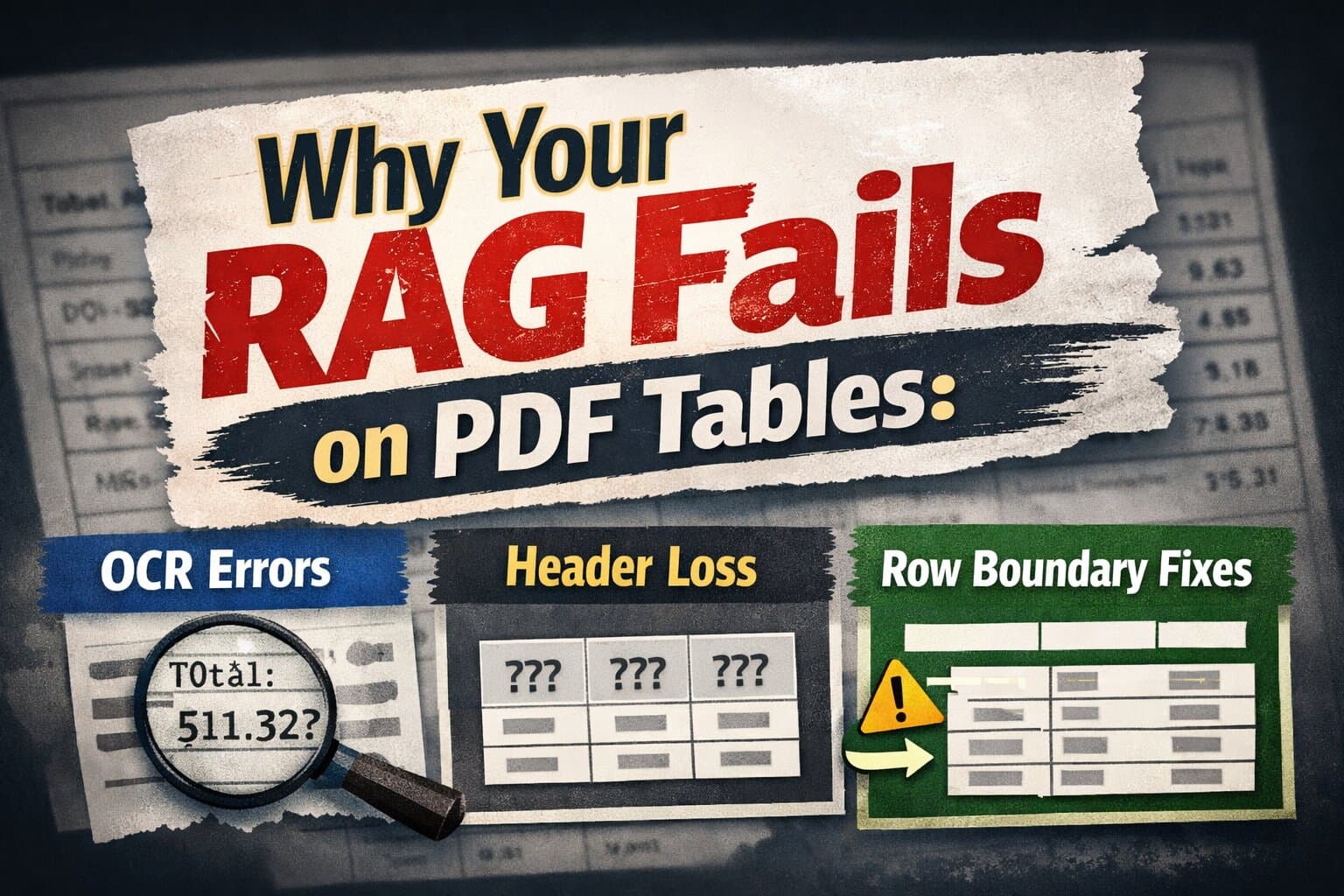
- a table row is separated from the header that defines each column
In those cases, topic-level recall can look acceptable while full-answer recall is poor. The system finds the topic but not the complete evidence.
When chunks are too large
Large chunks preserve more surrounding context, but they often weaken retrievability. One vector now represents several ideas at once. The answer-bearing span becomes less salient inside the embedding, and the model may receive broad context with weak local precision.
Common failure modes:
- top-k returns broad sections that mention the topic but not the answer
- reranking has to work harder to isolate the right passage
- final context includes unnecessary text, raising token cost and contradiction risk
- specific literals like SKUs, version constraints, or error codes get buried inside generic prose
Important
Smaller chunks do not automatically improve recall. If your corpus expresses answers as multi-clause rules, a chunk that is too small can destroy the evidence you were trying to retrieve.
Overlap: what it preserves, and what it breaks
Overlap exists to reduce boundary damage. It helps when the useful unit crosses a split point: long sentences, section intros, parameter blocks, exception clauses, or multi-step instructions.
But overlap is not free. Heavy overlap creates sibling chunks that are almost identical, which can crowd out diversity in the candidate set and waste context tokens later.
Overlap usually helps when:
- sentences or clauses frequently run across chunk boundaries
- headings need a few following lines to become meaningful
- numbered steps depend on the previous or next step
- the parser cannot preserve structure perfectly, so some continuity must come from text repetition
Overlap usually hurts when:
- top-k is dominated by near-duplicate siblings from the same source
- reranker cost grows without material recall gain
- final context repeats the same paragraph with slightly shifted boundaries
- the system loses document diversity and misses the one different source that mattered
For many corpora, around 10 to 20 percent overlap is a better starting point than aggressive 30 to 50 percent overlap. But even that should be validated, not assumed.
Document-aware chunking usually beats fixed windows
Fixed token windows are easy to implement, but enterprise documents are structured objects, not flat text streams. Headings, bullets, warnings, tables, examples, and exception clauses are semantic boundaries. Ignoring them is one of the fastest ways to lower effective recall.
Document-aware chunking should try to preserve:
- heading + immediate explanatory body
- rule + exception in the same retrievable unit when possible
- table header + relevant rows
- parameter name + type + constraints + example
- procedure title + prerequisites + step group
In practice, this often moves retrieval quality more than changing from one reasonable embedding model to another. The biggest win is not a magic token count. It is preserving the answer-bearing unit the way the source actually expresses it.
| Source type | What usually breaks recall | Better chunking move |
|---|---|---|
| Policies / eligibility rules | clauses and exceptions split apart | section-aware chunks that preserve rule + exception pairs |
| API docs | parameter meaning detached from examples or limits | heading-aware blocks for endpoint, parameters, and examples |
| Troubleshooting guides | steps broken across chunks with no sequence preserved | group steps and preserve prerequisites / warnings |
| Tables / matrices | rows lose header meaning | normalize tables into retrievable row-plus-header units |
How chunking failures show up in production traces
If you log retrieval candidates and final context, chunking problems have recognizable signatures:
| Trace symptom | Likely chunking cause | First fix |
|---|---|---|
| Right doc appears, but missing decisive exception clause | chunks too small or boundary split | increase clause completeness or use structure-aware chunks |
| Top-10 is filled with near-identical chunks from one section | overlap too high or weak dedupe | reduce overlap and dedupe sibling chunks before rerank |
| Retrieved chunks mention topic broadly but not the answer | chunks too large and semantically diluted | use smaller child chunks or heading-scoped sections |
| Tables never retrieve even when humans know the answer is there | table structure lost during parsing or chunking | normalize tables into row-aware or cell-aware retrieval units |
| Procedures come back out of order or half-complete | step boundaries broken across chunks | chunk by step groups and preserve local sequence |
These are often visible long before answer quality dashboards tell you what is wrong. If the same sibling chunks repeat everywhere, or the retrieved unit consistently lacks the qualifier that changes the answer, you already know where to look.
The eval that actually picks the right chunking strategy
The mistake is choosing chunking by feel. The right way is to compare candidate strategies on a labeled set of real queries and inspect failure cohorts.
Step 1: build a gold set with answer-bearing spans
For each query, label the source and the specific passage, clause, row, or step group that makes the answer correct. This matters because document-level relevance is too coarse for chunking decisions.
Your labels should capture:
- whether the answer exists in the corpus at all
- the gold document or section
- the answer-bearing span that must be preserved
- query cohort, such as policy, API, troubleshooting, pricing, or compliance
Step 2: compare strategies on more than recall@k
Recall@k matters, but it is not enough. Compare chunking strategies on the same corpus and measure:
- Candidate recall@k: did the gold source appear?
- Full-span recall: did at least one retrieved chunk contain the decisive span intact?
- Selection recall: did the useful chunk make it into final context?
- Duplicate rate: how many candidates are near-identical siblings?
- Context precision: how much of final context is useful instead of repetitive or broad?
- Token cost / latency: how much retrieval and context inflation did the strategy introduce?
Full-span recall is the metric many teams miss. A strategy can look fine on candidate recall while still fragmenting the decisive evidence.
Step 3: inspect failures by document cohort
One global chunking strategy is rarely optimal across every corpus. Policies, API docs, and troubleshooting manuals behave differently. Compare performance by cohort before you declare a winner.
If one strategy wins on API docs and loses on policies, the correct answer may be document-type routing rather than one compromise setting for everything.
Chunking eval checklist
Queries
  ↓
Gold source + answer-bearing span labeled
  ↓
Run strategy A / B / C on same corpus
  ↓
Measure recall@k + full-span recall + duplicate rate
  ↓
Inspect failures by document type
  ↓
Choose strategy by evidence, not token folklore
Starting defaults by document type
These are starting points, not universal truths. Use them to seed the eval, not to skip it.
| Document type | Starting chunk size | Starting overlap | Notes |
|---|---|---|---|
| Policies / FAQs | 150 to 300 tokens | 10 to 15% | preserve heading, rule, and exception together when possible |
| API / reference docs | 200 to 400 tokens | 10 to 20% | keep endpoint, parameter block, limits, and examples aligned |
| Troubleshooting / how-to | 300 to 500 tokens | 10 to 20% | group step clusters with prerequisites and warnings |
| Long reports / manuals | 400 to 800 tokens within section boundaries | low overlap | often better with hierarchical retrieval than one flat strategy |
When to use parent-child or hierarchical retrieval
Parent-child retrieval is useful when you need both precision and surrounding context. The retriever searches small child chunks, then expands to a larger parent section for the final prompt.
This is usually worth it when:
- documents are long and strongly structured
- answers live in one narrow span, but interpretation needs nearby section context
- fixed overlap keeps producing duplicates without solving boundary loss
- you want small retrieval units without forcing the model to reason from tiny isolated fragments
A common starting pattern is: retrieve 150 to 250 token child chunks, then attach an 800 to 1,500 token parent section if that improves grounded answer rate without blowing up context precision.
What to fix before you touch embeddings
Many retrieval projects jump to a new embedding model too early. Before that, verify the basics:
- parsing is not destroying headings, tables, lists, or code blocks
- duplicate or near-duplicate documents are controlled
- stale versions are not competing with current versions
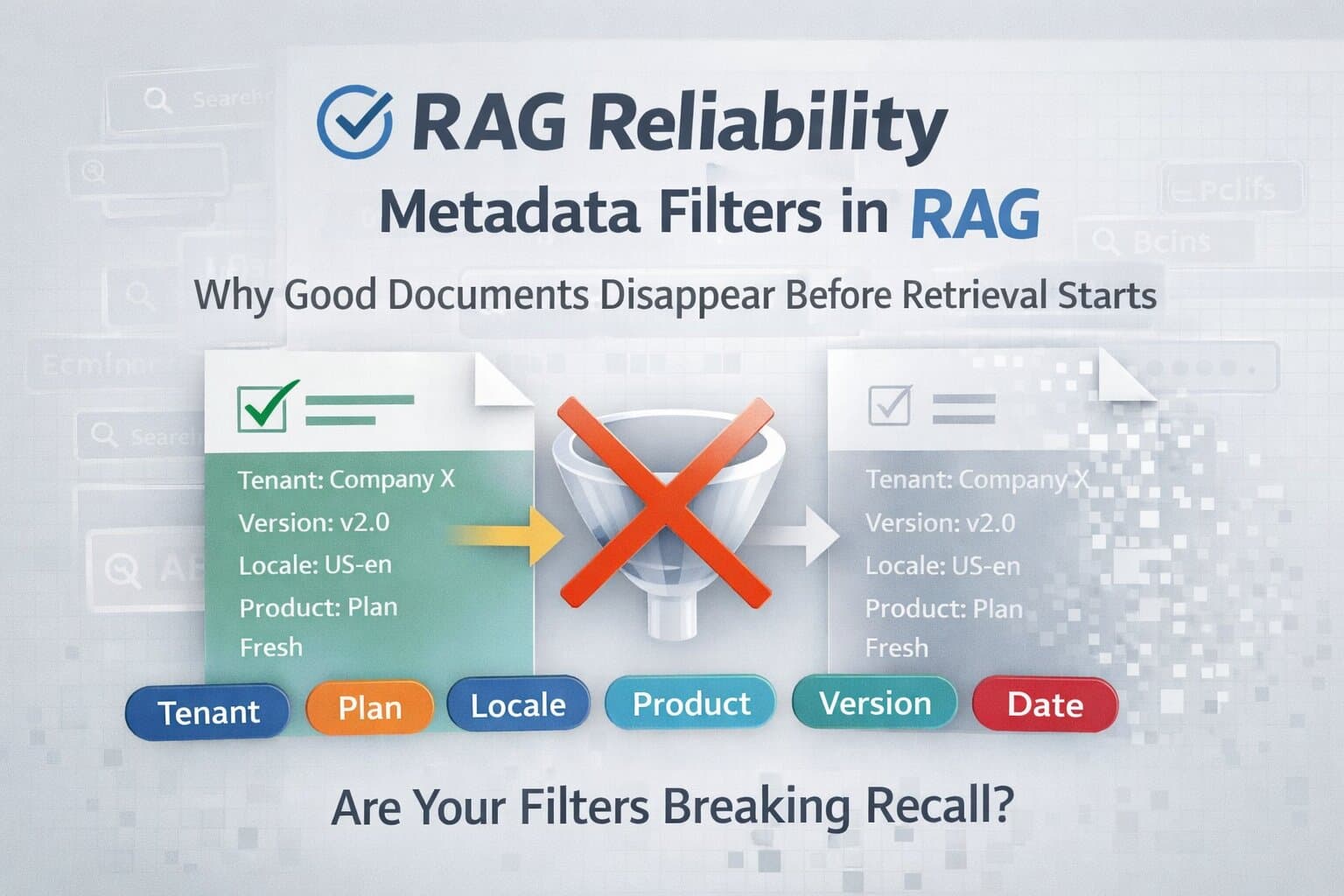
- metadata filters are applied correctly by product, region, plan, or version
- you have a labeled eval set that can prove chunking improvements
If those are broken, embedding changes mostly add movement, not clarity.
Want us to diagnose chunking and retrieval?
A good chunking strategy is not a number. It is an evidence-backed choice tied to your corpus, your queries, and your failure modes. If recall is weak, users say "it's in the docs," or your top-k is full of near-duplicates, chunking deserves a real audit.
Need a retrieval diagnosis that goes beyond "just increase k"?
We audit chunking, hybrid retrieval, reranking, and context construction against real traces and eval sets. The goal is not prettier retrieval dashboards. The goal is higher grounded answer rate with measurable before/after evidence.
FAQ
Questions readers usually ask next
What is the best chunk size for RAG?
There is no universal best size. The right chunk size is the one that keeps answer-bearing units intact for your corpus and query patterns. For dense policies or FAQs, smaller chunks often help. For long narrative sections, slightly larger section-scoped chunks or parent-child retrieval usually work better.
Does smaller chunk size always improve recall?
No. Smaller chunks can improve targeting, but they also split rules, qualifiers, exceptions, and procedures across boundaries. If the decisive evidence is fragmented, recall for the full answer span can get worse even when topic-level retrieval looks better.
How much overlap should I use for RAG chunking?
Use enough overlap to preserve continuity at chunk boundaries, but not so much that your index fills with near-duplicates. For many production corpora, around 10 to 20 percent overlap is a reasonable starting point. The correct value depends on sentence length, structure, and whether you already use parent-child retrieval.
Why is document-aware chunking better than fixed windows?
Because enterprise documents are not random token streams. Headings, lists, tables, examples, and exception clauses carry meaning. Respecting those boundaries keeps the retrievable unit aligned with how the answer is actually expressed in the source.
When should I use parent-child chunking in RAG?
Use parent-child retrieval when you need small, precise retrieval units but still want the model to see broader context. It is especially useful for long policies, API references, and manuals where the answer lives in one passage but surrounding section context still matters.
What to measure
Compare chunking strategies on full-span recall, duplicate rate, and final-context precision, not only candidate recall.
What teams get wrong
Treating chunk size as a global magic number instead of a document-type and evidence-preservation problem.
Need chunking decisions backed by traces and evals?
We baseline retrieval failures, compare chunking strategies against real queries, and ship the fix order through an AI Audit and Optimization Sprint.
Last updated
March 14, 2026