The core idea
Fix order beats random tuning. Diagnose → fix in order (freshness → recall → precision → grounding) → prove with evals. We ship PRs behind flags, not just advice.
Wrong answers in RAG are rarely "model problems." They're usually system problems: retrieval misses, stale indexes, over-long context, weak citation discipline, or tool loops that quietly degrade the answer.
And the fastest way to fix them is not "increase k" or "swap embeddings." It's to apply a fix order that stops the highest-leverage failure modes first—while keeping you from accidentally improving one metric and breaking another.
This page explains what we actually change in a RAG optimization sprint (not just prompts), and the exact order we use to stop wrong answers fast.
Context
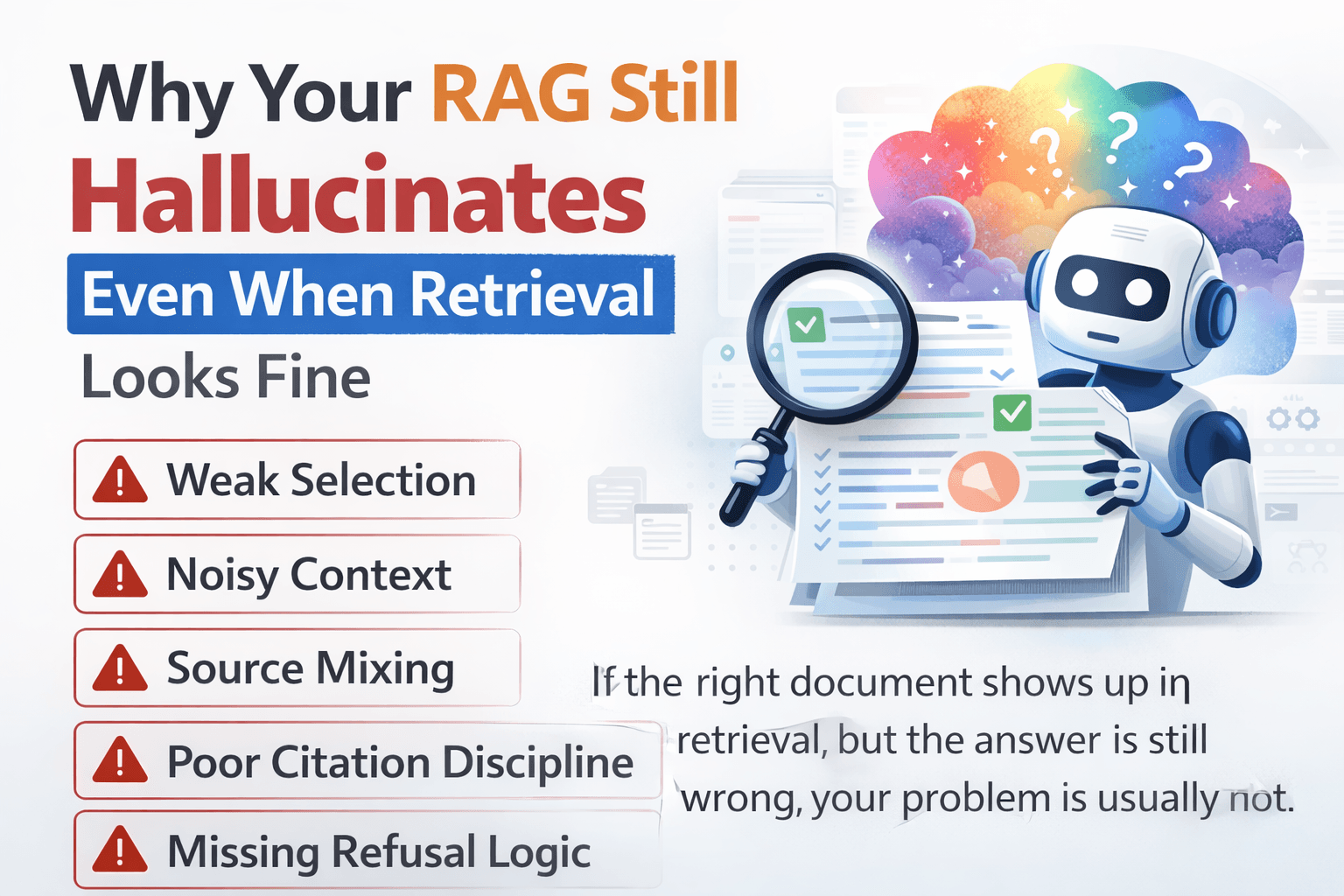
Part of the RAG Reliability hub: RAG Reliability Hub. See also: Why RAG Still Hallucinates When Retrieval Looks Fine, AI Optimization Services, RAG Recall vs Precision Diagnostic, RAG Wrong Answers Triage, AI System Audit.
What "wrong answers" usually mean in production RAG
When teams say "RAG is wrong," it typically falls into one of these buckets:
- Retrieval miss — The answer exists in your docs, but the retriever doesn't surface it.
- Wrong context — Retriever surfaces something—just not the right thing.
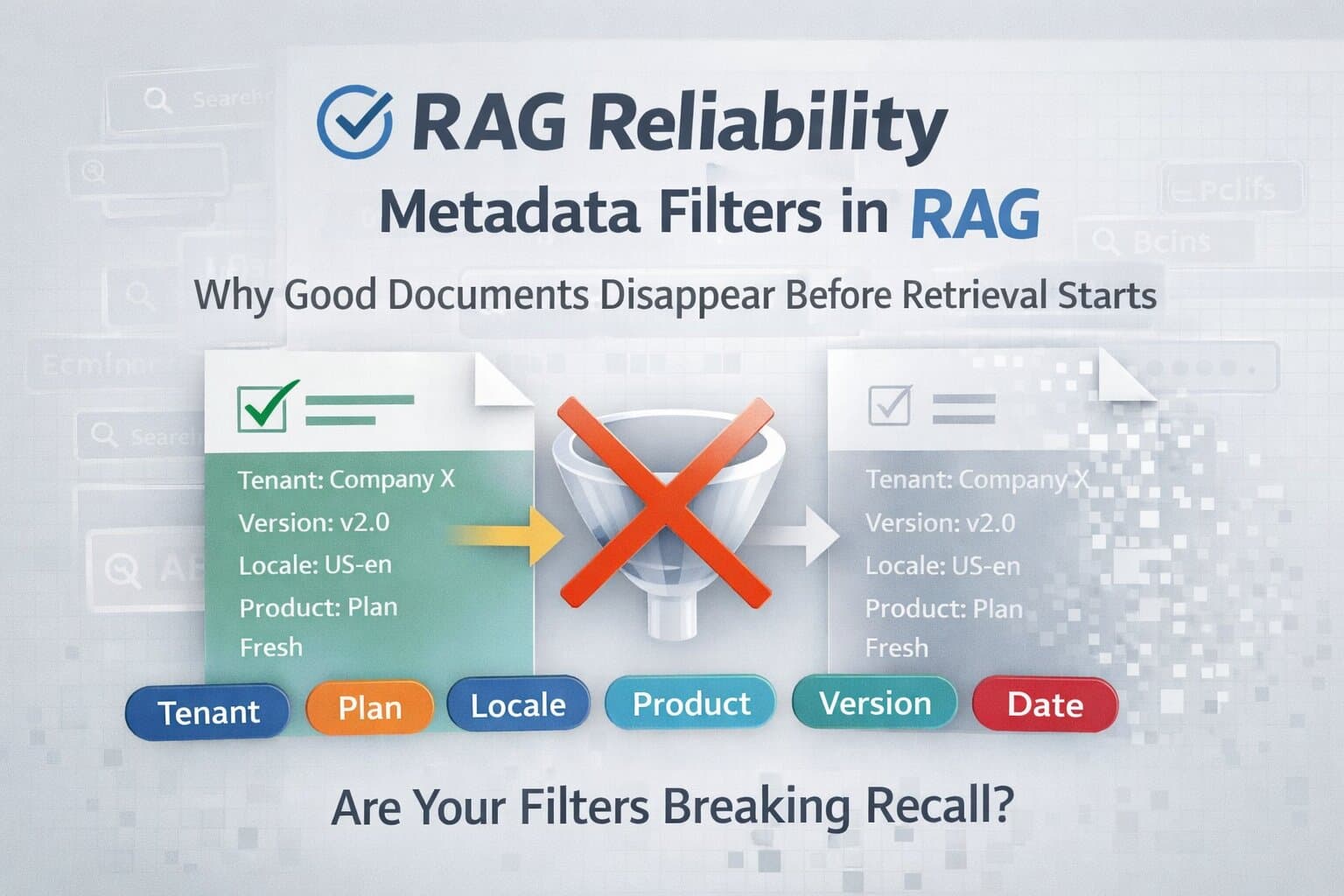
- Stale or mismatched content — Your docs changed, but the index/cache didn't. RAG is answering from an older universe.
- Context overload — Too much text is stuffed into context; the model picks the wrong snippet or merges sources.
- Generation overreach — The model fills gaps because it's not constrained by citations, schema, or "don't guess" policy.
- Tool + agent side effects — Tool errors, retries, or loops cause partial context and brittle behavior.
If you don't diagnose which bucket you're in, you'll waste time on the wrong fix.
The core idea: Fix order beats random tuning
Most RAG teams iterate like this:
- Increase k
- Try a reranker
- Try a new embedding model
- Change chunk size
- Add more prompt rules
- Hope
This is expensive, slow, and often makes answers less reliable.
Our approach is diagnose → fix in order → prove with evals.
The Fix Order (what we do first, second, third)
Step 0 — Define "correct" and measure it (or you can't ship fixes safely)
Before we touch retrieval, we set a baseline:
- Answer correctness (task success rate)
- Groundedness / citation coverage (is the answer supported by provided sources?)
- Retrieval accuracy (did we fetch the right source?)
- Context relevance (is the retrieved context actually useful?)
- Abstain rate (does the system say "I don't know" when it should?)
- Cost per successful answer (so fixes don't "improve quality" by spending 3×)
Artifacts you keep: a small golden set (50–300 queries), a lightweight eval harness, a failure taxonomy + scorecard.
Why first: without this, you'll "fix" wrong answers and introduce silent regressions elsewhere.
Step 1 — Stop the bleeding: freshness and versioning failures
If your content updates often, freshness is the #1 hidden cause of "wrong answers."
Common failure patterns:
- you re-crawl docs, but embeddings don't regenerate
- the vector store contains mixed versions
- caching returns old retrieval results
- reranker is using old doc IDs
- "top results" are from outdated pages
Fixes we ship:
- document versioning (doc_id + content_hash + ingest_timestamp)
- index rebuild rules (when to re-embed vs partial update)
- cache invalidation policy (retrieval cache keyed by version)
- staleness detection (serve-time check: "is source older than X?")
Artifacts you keep: ingestion checklist, index/version dashboard, "freshness gate" in CI.
Why now: no retrieval tuning matters if your system is answering from stale truth.
Step 2 — Fix retrieval misses (recall) with controlled changes
If the right document isn't retrieved, generation cannot recover.
We diagnose recall failures by splitting queries into cohorts: exact keyword (policy numbers, product SKUs), long natural language (support questions), multi-hop ("what's the refund policy for annual plan?"), entity heavy ("Acme Pro plan vs Business plan"), short ambiguous ("pricing").
Fixes we ship (in order):
- Hybrid search for keyword-heavy and entity-heavy queries (BM25 + embeddings)
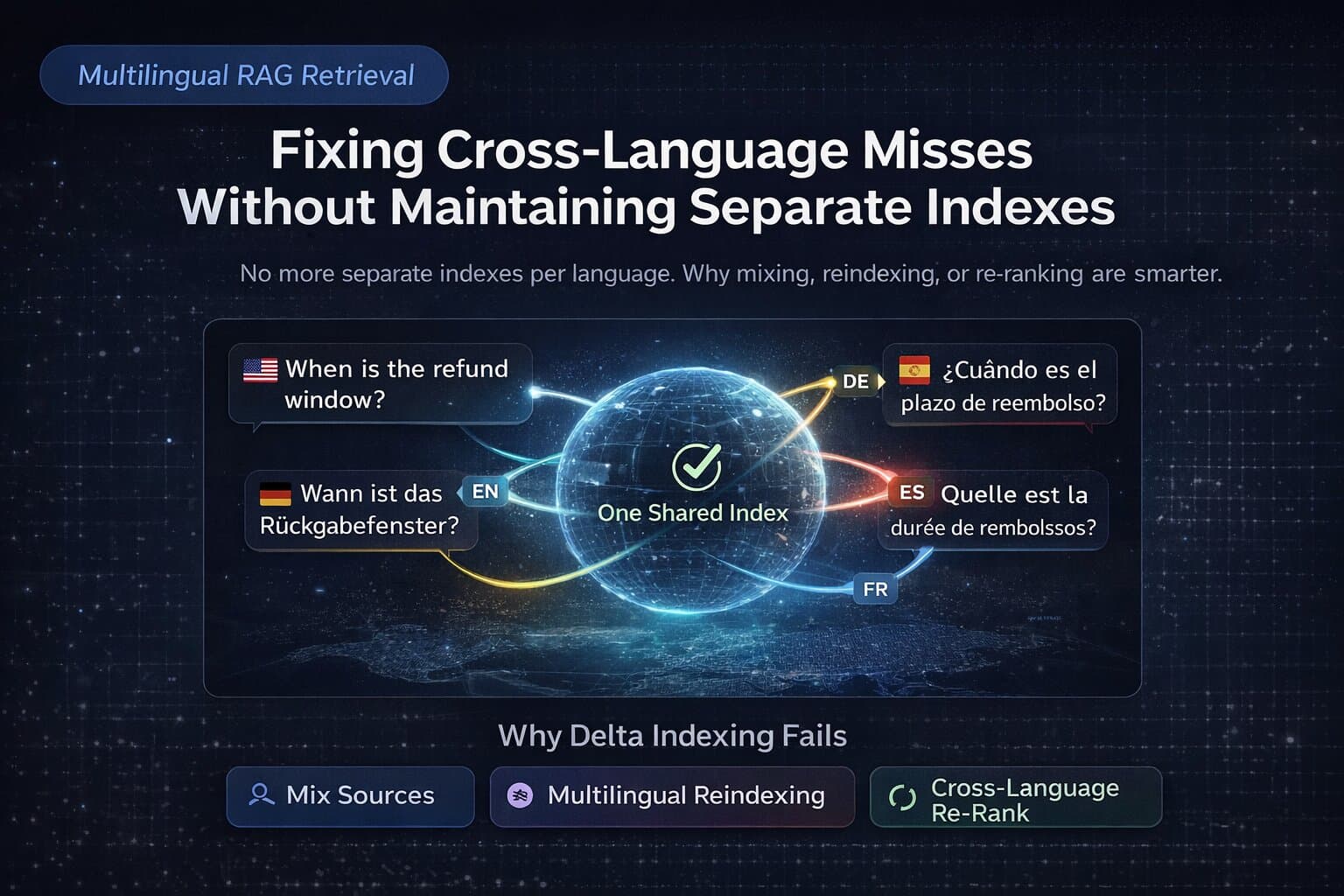
- Query normalization (strip noise, preserve entities, language detection)
- Index hygiene (dedupe near-identical chunks, remove boilerplate)
- Chunking by document type (policy ≠ FAQ ≠ spec sheet)
Artifacts you keep: retrieval policy doc (per cohort), recall@k baseline + dashboard, query cohort definitions.
Why now: recall is foundational—precision improvements won't help if you're missing the source.
Step 3 — Fix wrong context (precision) without inflating cost
Once recall is acceptable, wrong answers often come from irrelevant context getting through.
Typical causes: top-k includes "nearby but wrong" chunks; chunks are too large; duplicate passages crowd out diversity; embeddings retrieve semantically similar but policy-conflicting content.
Fixes we ship:
- dedupe + novelty filtering (limit semantic redundancy)
- max tokens per document (avoid one doc dominating)
- diversity retrieval (ensure multiple candidate sources)
- reranking policy (only apply when ambiguity is detected)
Artifacts you keep: context relevance eval, reranking decision rule ("when rerank is worth it"), spend impact report.
Why now: precision fixes can reduce wrong answers and reduce cost, but only after recall is stable.
Step 4 — Enforce grounded answers (stop "confident guessing")
Many "wrong answers" are actually unsupported answers. The model is guessing because it's allowed to.
We treat groundedness as a system contract, not a prompt suggestion.
Fixes we ship:
- citation requirement for claims (or structured output with source mapping)
- abstain behavior when context is insufficient
- answer-with-evidence format (quote/trace to specific chunk IDs)
- verification gates (soft → hard → enforced)
Three levels of grounding enforcement:
- Soft: prefer citations, measure groundedness
- Hard: reject answers missing citations for key fields
- Enforced: automatic "regenerate or abstain" until grounded or escalate
Artifacts you keep: groundedness rubric, citation coverage metric, verification pipeline.
Why now: if you don't enforce grounding, you'll keep chasing "model randomness."
Step 5 — Stop retrieving when confident (cut cost and reduce confusion)
Over-retrieval is a quiet killer: costs more, increases context conflicts, makes answers less consistent.
Fixes we ship:
- confidence thresholds: skip retrieval for "known stable intents" (hours, contact, simple policy pointers)
- intent classifier or rules-based router (cheap + reliable)
- retrieval budget caps per query cohort
Artifacts you keep: retrieval router rules, budget caps (tokens/time), hit-rate and savings dashboard.
Why now: do this after grounding and precision, or you may skip retrieval when you still need it.
Step 6 — Production hardening: timeouts, retries, and tool loops
Even if RAG is "correct," production failures can cause wrong answers: timeouts → partial context; tool failures → agent proceeds anyway; retries → duplicated context → incoherence.
Fixes we ship:
- consistent timeouts and retry policies
- tool error normalization
- stop conditions and escalation rules
- P95 tracing across retrieval/rerank/generation
Artifacts you keep: tracing spec, loop rate metrics, incident runbook.
What we deliver in a RAG Optimization Sprint (not just advice)
You keep real artifacts:
- Eval harness + golden set
- Retrieval cohort definitions (so you can test changes safely)
- Dashboards: retrieval accuracy, groundedness, wrong-answer rate, cost per success
- Retrieval policies: k, chunking, rerank rules, budgets
- CI regression gates (stop-ship thresholds)
We ship PRs behind flags:
- hybrid retrieval / reranking decisions
- chunking + indexing changes
- verification and grounding pipeline
- routing + stop retrieving controls
- reliability improvements (timeouts/retries/tool handling)
Typical timeline
Week 1: Diagnose + baseline
- Build golden set (50–200)
- Run triage on wrong-answer logs
- Measure retrieval vs generation failures
Week 2–3: Fix order changes (highest ROI first)
- freshness/versioning gates
- recall & precision tuning
- grounding enforcement
Week 4–6: Hardening + rollout
- CI gates
- dashboards + alerts
- staged deploy and monitoring
When you should start with an AI Audit instead
If you can't answer these today:
- What % wrong answers are retrieval misses vs ungrounded generation?
- How stale is your index relative to content updates?
- Which cohort of queries fails most?
- What's cost per successful answer?
…then the fastest path is not "RAG tuning." It's an AI Audit to baseline and decompose failures.
CTA: Stop wrong answers fast — start with an Audit → Sprint
If you want wrong answers to drop fast without inflating cost:
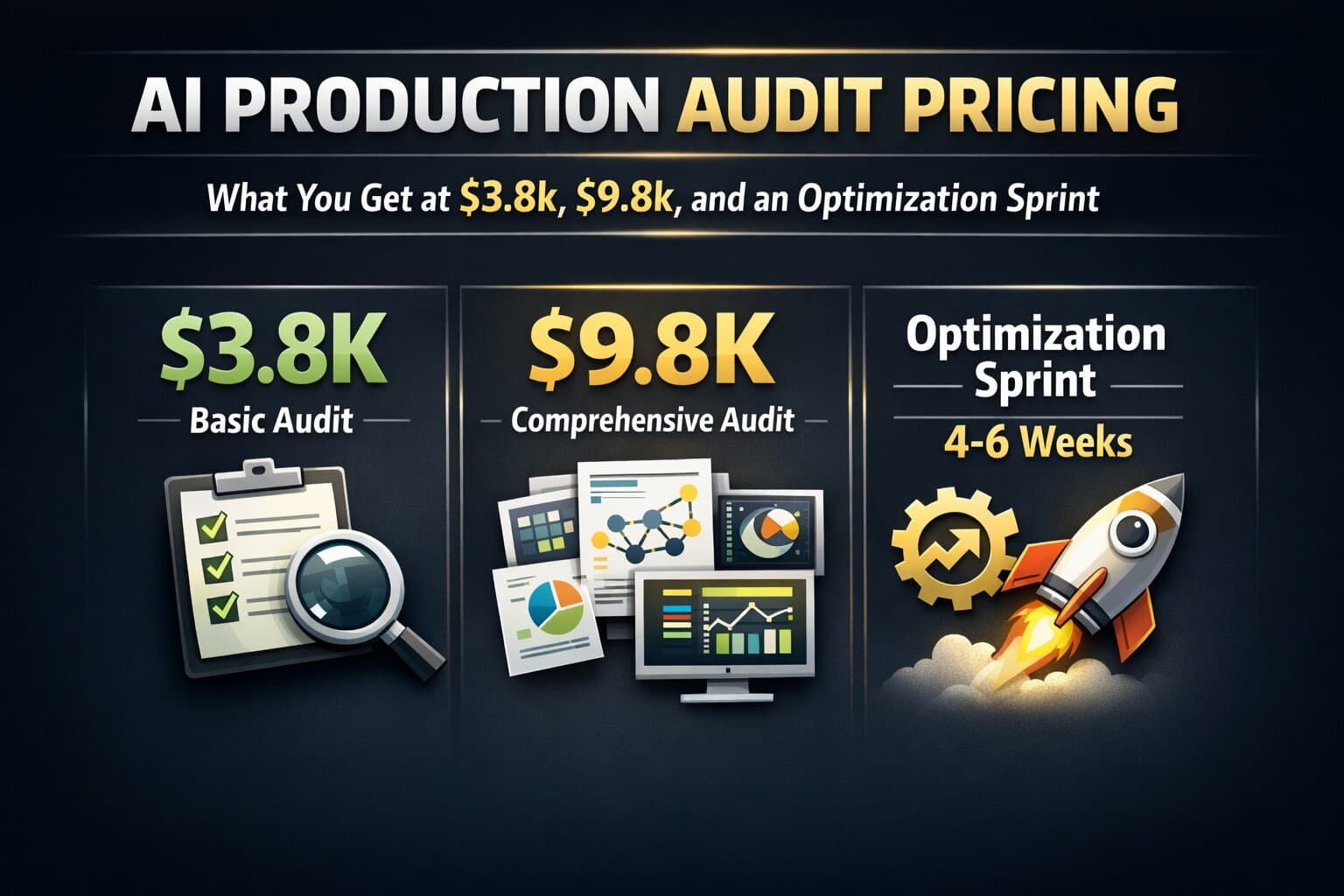
- Start with a short AI Audit (baseline + failure taxonomy + ROI roadmap)
- Then run a RAG Optimization Sprint (ship PRs, prove improvements, add CI gates)
See our AI Optimization Services for RAG optimization sprints—with before/after benchmarks.
FAQ
Questions readers usually ask next
Do you just tweak prompts for RAG optimization?
No. Prompts help, but the biggest wins come from retrieval policy, freshness/versioning, groundedness enforcement, and production reliability controls. We ship real changes: hybrid retrieval, reranking decisions, chunking, verification pipeline.
Will reranking fix wrong answers in RAG?
Sometimes. But adding reranking without fixing freshness, chunking, and dedupe often increases latency and cost without improving truth. We apply reranking only when ambiguity is detected—after recall and precision are stable.
Can you reduce wrong answers without increasing cost?
Yes—most systems are paying for waste (over-retrieval, retries, loops). Fixing those often improves accuracy and lowers spend. We add confidence thresholds to skip retrieval for known stable intents, and cap retrieval budgets per cohort.
Stop wrong answers fast
Start with an AI Audit for baseline + failure taxonomy. Then run a RAG Optimization Sprint.
Last updated
February 20, 2026