The core idea
Do not optimize the invoice directly. Optimize the system that creates the invoice: waste, context, routing, caching, and regression control.
Most teams try to reduce an OpenAI bill by cutting prompts, lowering max tokens, or swapping to a cheaper model. That sometimes works for a week. Then answer quality drops, support escalations rise, and the team quietly puts the cost back.
The problem is not cost reduction. The problem is cutting cost without a diagnostic model. If you do not know where spend comes from, which workloads need quality headroom, and what guardrails define success, your "optimization" is just budget-driven degradation.
This article gives you a practical audit framework we use in production systems: define success first, decompose spend by stage, stop silent waste, reduce context with evidence, route cheaper models where safe, then prove before and after with a scorecard.
Context
Part of the Cost Optimization hub. See also: OpenAI Bill Audit in 45 Minutes, LLM Cost Optimization Service, Caching for Cost and Correctness, AI Production Audit.
Why cost cuts usually hurt quality
There are three common reasons teams hurt quality while trying to save money:
- They optimize the invoice, not the system. The bill is the outcome. The real drivers are context, retries, tool loops, retrieval policy, and routing mistakes.
- They measure cost per request, not cost per successful task. Cheap failures can look efficient on a dashboard.
- They cut global settings instead of segmenting by cohort. The cheap path that works for simple FAQ traffic may break expert or long-tail queries.
Safe cost work is not "make everything smaller." It is: remove waste, keep the quality you actually need, and make tradeoffs explicit.
The audit framework at a glance
| Step | Question | Main output |
|---|---|---|
| 1 | What outcome must stay intact? | Quality guardrails and success definition |
| 2 | Where does spend actually come from? | Stage-level spend breakdown |
| 3 | What waste can be removed first? | Retry, loop, timeout, and over-generation fixes |
| 4 | How much context is actually necessary? | Context budget by stage and workload |
| 5 | Where can a cheaper model safely take over? | Routing policy with eval thresholds |
| 6 | What repeated work should be reused? | Caching and batching plan |
| 7 | Did savings hold without regression? | Before/after scorecard |
Step 1: Define success and guardrails before cutting anything
Start with the outcome that matters: correct grounded answer, task completed, ticket resolved, or workflow completed without escalation. Then define the guardrails you will not violate.
Minimum guardrails:
- answer quality or groundedness does not regress past the agreed threshold
- P95 latency does not become materially worse
- escalation or fallback rate does not jump
- security and policy checks still pass
If your team cannot name these guardrails in one minute, it is too early to cut cost aggressively. You are missing the contract that makes optimization safe.
Minimum metric set
- cost per successful task
- quality or groundedness score
- failure or escalation rate
- P95 latency and time to first token
- cohort splits by intent, tenant, document type, or workflow
Step 2: Decompose spend by stage, not by invoice total
An invoice total tells you nothing about what to fix. Break cost into the stages that actually create spend:
- base generation: the normal prompt and response path
- context: system prompt, history, retrieval, tool outputs
- waste: retries, timeouts, repeated tool calls, abandoned attempts
- routing: which model handled which workload
This is where teams usually discover the uncomfortable truth: the biggest spend bucket is not the model itself. It is the surrounding system behavior.
If you need a fast teardown method, start with our 45-minute OpenAI bill audit. The point here is not perfect accounting. It is getting enough stage visibility to choose the right fix order.
Step 3: Stop silent waste first
Silent waste is the highest-confidence savings bucket because it rarely improves quality. It just burns money.
Look for these patterns first:
- timeout storms that trigger repeated full-chain retries
- tool loops where the agent keeps trying without new information
- duplicate retrieval or rerank calls for the same request
- verbose outputs for workflows that only need a short structured result
- fallback chains that call multiple expensive models before giving up
Fixing waste first matters because it reduces cost without forcing a quality tradeoff. It also stabilizes the system so later measurements are cleaner.
Typical outputs from this step:
- retry ownership in exactly one layer
- tool-call ceilings and explicit stop conditions
- output length budgets by intent
- duplicate-call detection
Step 4: Reduce context without breaking correctness
Context is the most common cost leak in production LLM systems. But context cutting is also where quality gets damaged if teams act blindly.
The right question is not "How do we use fewer tokens?" It is "Which tokens actually move the answer quality needle for this workload?"
Audit these context buckets separately:
- system prompt and policy scaffolding
- conversation history
- retrieved chunks and reranked context
- tool outputs fed back into the model
Safe context reductions usually include:
- modular prompts instead of one giant universal system prompt
- history summarization or state extraction instead of raw transcript replay
- retrieval dedupe and novelty filtering
- max token budgets per stage
- structured tool summaries instead of raw tool dumps
If you have RAG, context reduction must be paired with retrieval evals. Otherwise the team will cut retrieval too far and blame the model when recall collapses.
Step 5: Route cheaper models only where eval says it is safe
Model routing can produce step-function savings, but only when it is treated as a measured policy rather than a blanket downgrade.
A practical routing policy asks:
- Which intents are simple enough for a cheaper model?
- Which cohorts need the stronger model because failure cost is high?
- What confidence signal triggers escalation?
- What eval threshold must hold before rollout?
The usual mistake is routing by hope: "maybe the mini model is good enough now." Safe routing needs cohort-based evals and clear fallback rules.
Cheap-first routing rule
Send low-risk, high-volume, low-complexity work to the cheaper path first. Escalate only when confidence, task complexity, or policy sensitivity says you need more model headroom.
Step 6: Add caching and batching after behavior is stable
Caching is powerful, but it should not be the first fix when the system is still unstable. If retries, context sprawl, and routing chaos are unresolved, caching can mask the wrong behavior instead of improving it.
Once the pipeline is more predictable, caching and batching can deliver durable savings:
- prompt-prefix caching for repeated scaffolding
- retrieval or rerank caching for repeated searches
- response caching only for low-risk stable answers
- batching where latency budgets allow it
The important constraint is correctness. Treat caching as a controlled cost feature, not a shortcut. Our caching playbook covers key design, invalidation, and validation gates.
Step 7: Prove the savings without quality regression
This is where most teams stop too early. They see the invoice go down and declare victory. A real optimization only counts if the business outcome still holds.
Run the same before/after comparison on:
- cost per successful task
- quality or groundedness score
- failure, fallback, or human-escalation rate
- P95 latency
- high-risk cohorts
If the cheap path saves money but pushes more work to support, more retries to users, or more escalations to humans, the savings are false.
A simple scorecard for engineering and finance
You do not need a giant dashboard to govern cost work. You need one scorecard that both engineering and finance can read.
| Metric | Why it matters | Bad sign |
|---|---|---|
| Cost per successful task | Ties spend to outcomes | Flat invoice but more failures or escalations |
| Grounded quality or task score | Protects trust | Cost drops after removing useful context |
| Fallback or human-escalation rate | Catches hidden quality loss | More tickets or manual reviews after optimization |
| P95 latency | Protects UX and conversion | Cheap model path is slower because retries rise |
When to escalate to a real audit
Use this framework as a working guide. Escalate to a formal audit when any of these are true:
- you cannot explain the top two spend drivers with evidence
- cost spikes and wrong answers appear in the same cohorts
- each optimization changes quality in unpredictable ways
- finance wants savings and leadership wants proof that trust will not drop
- you suspect the problem is retrieval, routing, and observability together rather than one isolated prompt
At that point, the right next step is not another guess. It is a baseline, a failure taxonomy, and a prioritized fix roadmap.
Need a practical cost-reduction roadmap?
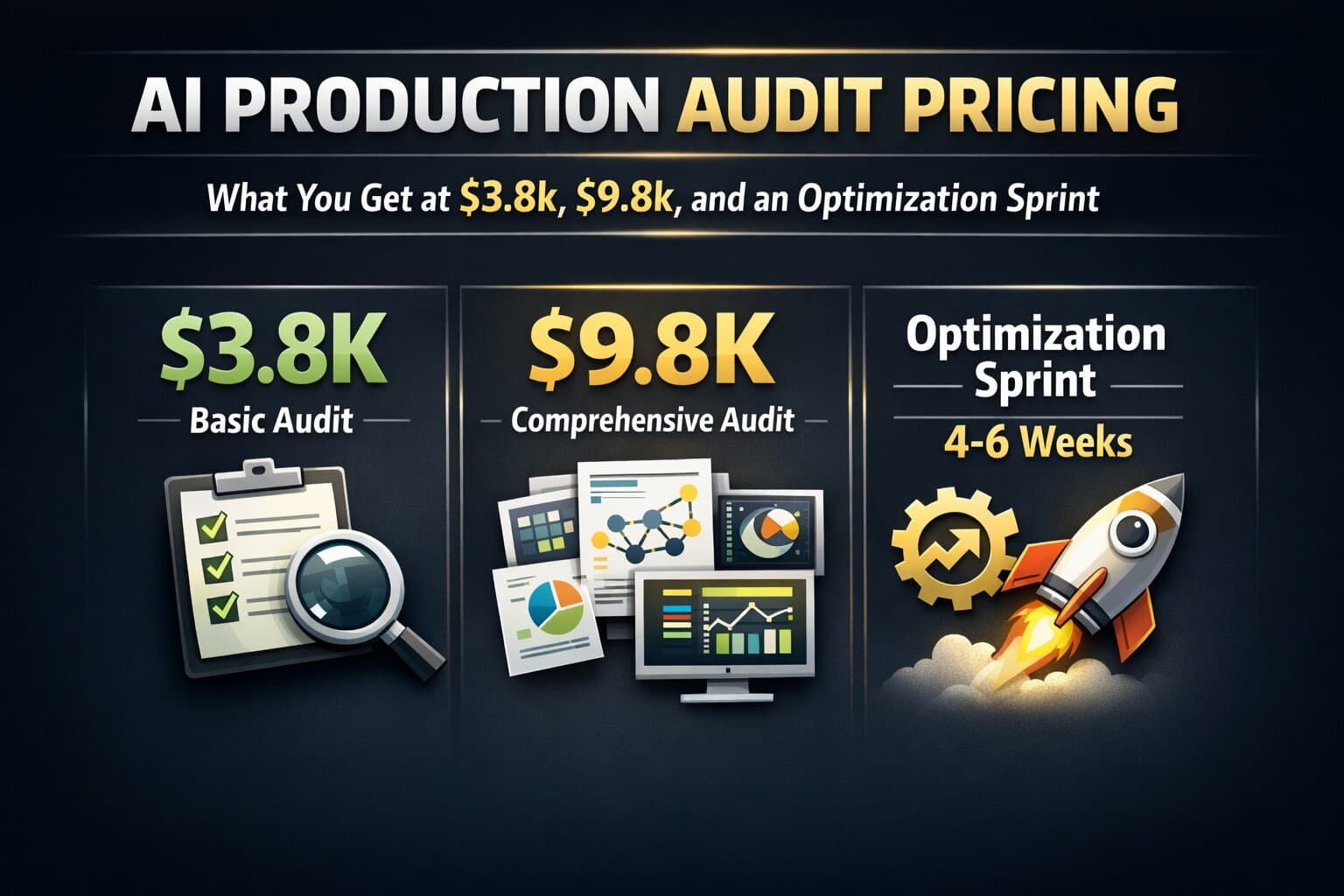
We run a production AI audit to baseline quality, cost, latency, and failure modes, then turn that into a fix order you can ship. See also our inference cost reduction case study for a real before/after example.
FAQ
Questions readers usually ask next
What is the safest first move to reduce an OpenAI bill?
Usually it is not prompt shortening. The safest first move is to stop silent waste: retries, timeout cascades, tool loops, duplicate retrieval, and oversized context that adds cost without improving outcomes. Those fixes often reduce spend while improving reliability.
Can we lower OpenAI cost without changing the model?
Yes. Many teams get meaningful savings from context budgets, retrieval pruning, output constraints, retry policy fixes, prompt modularization, and caching before they ever change model routing. Model changes are powerful, but they are not the only lever.
How do we know cost cuts did not hurt quality?
Measure before and after on the same task set. Track cost per successful task, groundedness or answer quality, failure rate, escalation rate, and P95 latency by cohort. If one improves while the others silently degrade, the savings are not real.
When do we need a formal audit instead of ad hoc optimization?
You need a formal audit when nobody can explain where spend is coming from, when wrong answers and cost spikes appear together, when prompt changes cause random regressions, or when leadership wants ROI proof before approving more spend.
Best first question
Which spend bucket is largest right now: waste, context, routing, or model overkill? That answer determines fix order.
Most common trap
Cutting prompts globally and declaring success before checking groundedness, fallback rate, and high-risk cohorts.
Need cost cuts with proof?
We use audit-first cost optimization: baseline the system, remove waste, install guardrails, and prove the before/after. See the AI Production Audit and Optimization Sprint.
Last updated
March 9, 2026