The Core Metric
Reliability is not an afterthought; it is a feature. If you spend your error budget, your next feature is a stability fix.
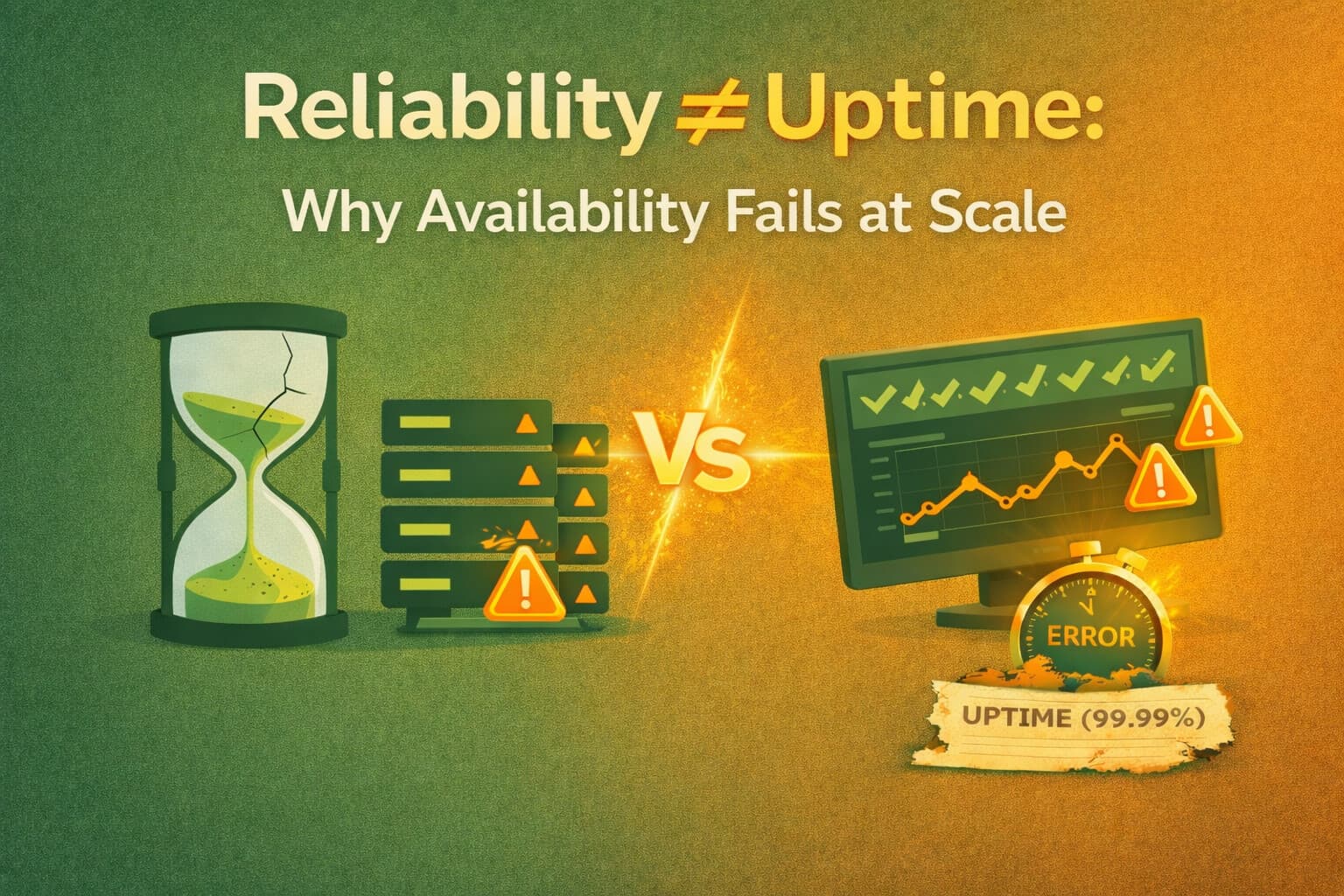
Most teams think scaling is a technical challenge. In reality, it is a human one. When "Scalable Architecture" fails, it doesn't just crash servers—it crashes people.
In our cornerstone guide on Scalable Architecture, we defined operability as a system's ability to be managed without heroics. Error Budgets are the practical mechanism that enforces this operability, preventing on-call burnout before it starts.
The scaling trap: Velocity vs. Reliability
As traffic grows, the pressure to ship features often overrides the need for stability. Without a clear policy, "Scaling" becomes a euphemism for "piling on technical debt." This leads to a burnout loop: more features → more bugs → more on-call pages → exhausted engineers → lower quality code.
What exactly is an Error Budget?
An Error Budget is the amount of downtime or errors your service is allowed to accumulate over a specific period (usually 30 days) while still meeting your Service Level Objective (SLO).
"100% reliability is almost always the wrong target. It's too expensive and slows down innovation."
How Error Budgets protect your on-call team
On-call burnout isn't caused by one bad night; it's caused by unrelenting uncertainty. Error Budgets protect teams by:
- Defeating the 'Hero' Culture: It removes the need for engineers to sacrifice their sleep to compensate for poor architecture.
- Providing Leverage: When the budget is low, the team has a data-backed reason to say "No" to new features.
- Focusing on p99s: As noted in our Resilience Patterns guide, protecting tail latency is key to keeping the budget intact.
Calculating your budget: The Math of SLOs
The math is simple but the impact is profound. If you define an SLO of 99.9% availability:
$$Error Budget = 100% - SLO%$$
For a 99.9% SLO, your budget is 0.1%. In a 30-day window, that is exactly 43.2 minutes of allowed downtime. Every incident, every 5xx error, and every slow request eats into this budget.
Spent your budget? Implementing the 'Feature Freeze'
This is where most teams fail. An Error Budget is useless if there is no consequence for spending it. When the budget hits zero, the team must switch from "Feature Velocity" to "Reliability Velocity."
The typical "Policy" includes:
- Suspending all non-emergency feature deploys.
- Redirecting 100% of engineering effort to technical debt, automation, and stability.
- Conducting deep post-mortems to identify why the budget was exhausted.
Transitioning to a data-driven culture
Scaling a team requires moving from blame to data. Error Budgets align incentives: Product Managers want features, Engineers want stability. The budget makes them co-owners of the user experience.
If you are currently struggling with scaling pain, start by baselining your current SLIs. Get a baseline reliability audit.
FAQ
Questions readers usually ask next
What is an Error Budget?
An Error Budget is the amount of downtime or errors your service is allowed to accumulate over a specific period (usually 30 days) while still meeting your Service Level Objective (SLO). For a 99.9% SLO, your budget is 0.1%—about 43.2 minutes of allowed downtime per month.
How do Error Budgets prevent on-call burnout?
Error Budgets provide data-backed leverage to say 'No' to new features when reliability is at risk. They remove the need for engineers to sacrifice sleep to compensate for poor architecture, defeat hero culture, and focus teams on preventing incidents rather than just responding to them.
What happens when you spend your Error Budget?
When the budget hits zero, teams must switch from 'Feature Velocity' to 'Reliability Velocity': suspend non-emergency feature deploys, redirect engineering effort to technical debt and stability, and conduct deep postmortems to identify why the budget was exhausted.
How do I calculate my Error Budget?
Error Budget = 100% - SLO%. For example, a 99.9% SLO gives you a 0.1% budget. In a 30-day window, that's 43.2 minutes of allowed downtime. Every incident, 5xx error, and slow request eats into this budget.
The Human Cost
On-call burnout is the #1 reason talented engineers leave scaling startups. Error Budgets provide the "Safe to Work" signal.
The Business Value
Reliable systems convert better. Use your budget to decide exactly when to take risks with new experiments.
Ready to Stop the Fires?
If your team spends more time in incident channels than in IDEs, your scaling model is broken. Let's design a sustainable on-call rotation.
Last updated
January 17, 2026