The Reliability Reframe
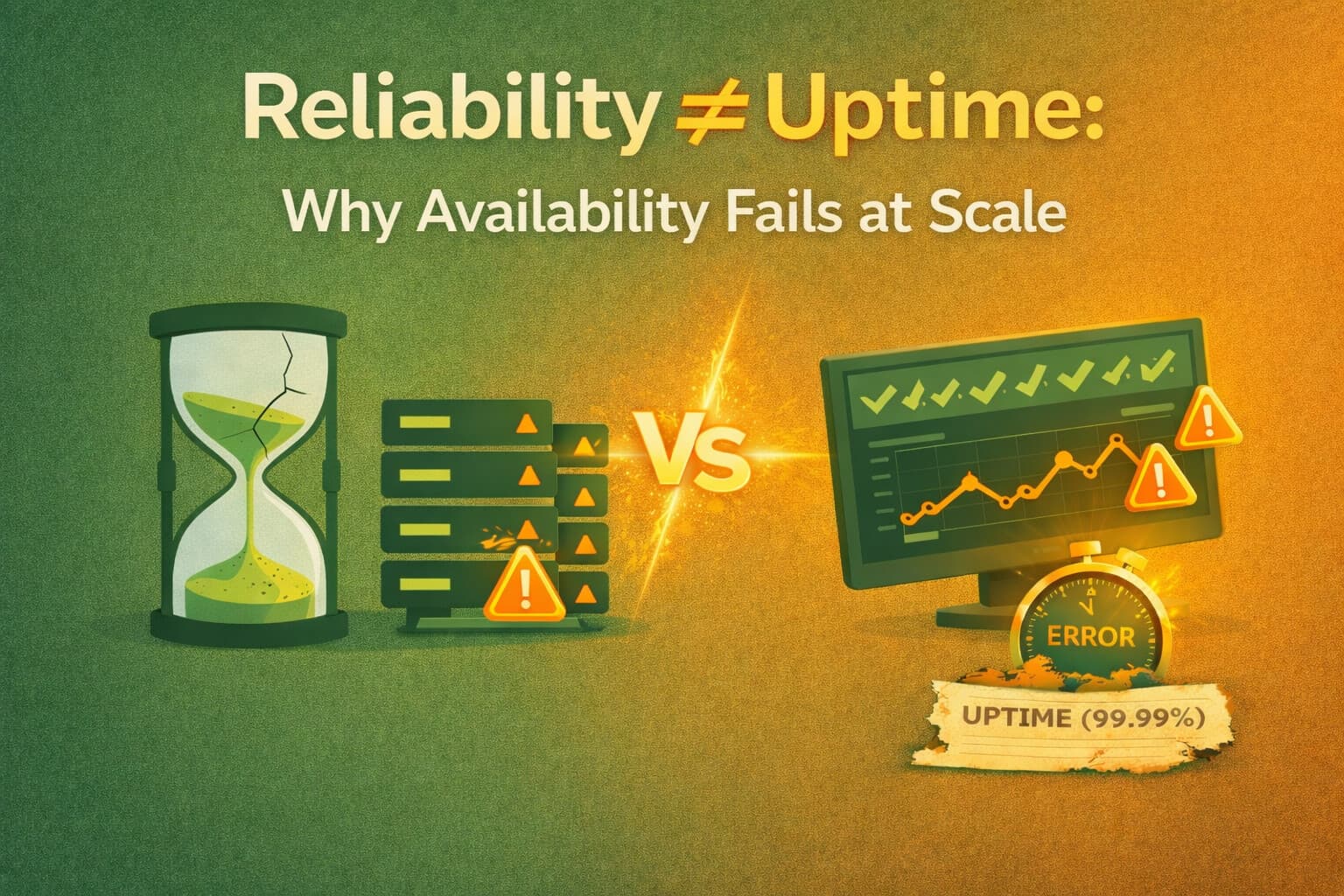
Uptime measures whether something responds. Reliability measures whether users can complete the journeys that matter—under failure, load, and uncertainty.
Most systems don't fail because they're down. They fail while dashboards are green, uptime looks fine, and alerts are quiet—yet users can't complete the flows that matter.
If you measure reliability as uptime, you're measuring the easiest part of production: whether something responds at all. Reliability is the harder problem: user outcomes under stress, partial failure, and recovery.
Uptime is binary. Reliability is not.
Uptime answers one question: Is the system responding? Reliability answers a different one: Can users consistently complete key journeys—under real load—when things go wrong?
Why this breaks at scale
- More dependencies: success requires more things to work at the same time.
- More variance: latency spikes, noisy neighbors, and uneven traffic shape the tail.
- More blast radius: retries and saturation amplify "small" failures into incidents.
Reality check
Your uptime can be "excellent" while checkout, login, or payments are unreliable. Most real incidents are partial failures, not total downtime.
Why availability fails at scale
1) Partial failures hurt more than total outages
Full outages are loud and obvious. Partial outages are subtle: a subset of users, regions, tenants, or endpoints fail while everything still looks "up". From uptime's perspective, the system is fine. From the user's perspective, it's broken.
2) Averages hide tail pain
Users don't experience averages. They experience the tail: p95/p99 latency, stalls, retries, and timeouts. A system with "good" average latency can still feel unusable when tail latency explodes under load.
3) Degradation is the default failure mode
Systems rarely flip from healthy to dead. They degrade: connection pools exhaust, queues back up, caches thrash, dependencies slow down, and retries amplify load. Uptime doesn't see gradual collapse—reliability does.
4) Recovery speed matters more than prevention
At scale, failures are inevitable. The difference between reliable and fragile systems is not whether they fail, but how fast you detect, contain, and recover. A system that recovers in minutes can outperform a "rarely failing" system that takes hours to restore.
What to measure instead of uptime
Start with user-centric SLIs
- Success rate for critical journeys (checkout, login, write paths).
- Tail latency (p95/p99) for those journeys, not overall averages.
- Correctness signals where "200 OK" can still mean broken behavior.
Turn SLIs into SLOs (and make them actionable)
- SLOs define acceptable unreliability; they are goals, not vanity numbers.
- Error budgets convert reliability into decisions: ship faster, slow down, or invest in stability.
- Burn rates tell you urgency: are you burning the budget in hours, days, or weeks?
Rule of thumb
If you can't answer "are users completing the primary journey right now?" within 30 seconds, you're not measuring reliability—you're measuring infrastructure health.
A practical reliability operating model
Reliability isn't a dashboard. It's an operating model:
- Define SLOs for the few journeys that represent your business.
- Use error budgets to govern change (deploys, risky migrations, feature rollouts).
- Design for failure with containment patterns (timeouts, retries with jitter, circuit breakers, bulkheads).
- Run incidents as feedback: postmortems that remove recurring failure modes.
- Prevent regressions: make reliability observable in every release, not just during outages.
For failure containment patterns, see: Designing for Failure: Timeouts, Retries, Circuit Breakers, and Bulkheads .
When to run a reliability audit
You likely need a reliability audit if:
- Uptime is "good" but customers report broken flows, timeouts, or inconsistent behavior.
- Incidents repeat, and postmortems don't change outcomes.
- Latency spikes under load even when CPU and memory look fine.
- Retries, timeouts, and queueing behavior are poorly understood—or tuned by superstition.
- On-call load is rising as the org or traffic grows.
What an audit should produce
A prioritized map of failure modes, the signals that detect them early, and the smallest set of changes that reduce user impact and on-call pain.
Summary: Stop chasing uptime
Uptime is a binary indicator that tells you whether something responds. Reliability is the probability that users can complete key journeys—consistently—under stress and failure.
If your dashboards are green but incidents keep happening, that's not bad luck. It's a sign you're measuring the wrong thing.
Need help finding the failure modes behind "green dashboards"? Schedule a Reliability Audit .
FAQ
Questions readers usually ask next
What's the difference between uptime and reliability?
Uptime is binary—it answers 'Is the system responding?' Reliability measures whether users can consistently complete key journeys under real load when things go wrong. Most production incidents are partial failures: the system is 'up' while critical user journeys are broken.
Why does availability fail at scale?
At scale, systems face more dependencies (success requires more things to work simultaneously), more variance (latency spikes, noisy neighbors, uneven traffic shape the tail), and more blast radius (retries and saturation amplify 'small' failures into incidents). Partial failures, tail latency, and degradation become the default failure modes.
What should I measure instead of uptime?
Measure user-centric SLIs: success rate for critical journeys (checkout, login, write paths), tail latency (P95/P99) for those journeys (not overall averages), and correctness signals where '200 OK' can still mean broken behavior. Turn SLIs into SLOs, use error budgets to govern change, and monitor burn rates to detect urgency.
When should I run a reliability audit?
Run a reliability audit if: uptime is 'good' but customers report broken flows/timeouts/inconsistent behavior, incidents repeat and postmortems don't change outcomes, latency spikes under load even when CPU and memory look fine, retries/timeouts/queueing behavior are poorly understood, or on-call load is rising as the org or traffic grows.
What uptime misses
Partial outages, tail latency, and silent degradation can break users while uptime stays "green".
What reliable teams do
Define SLOs, enforce error budgets, monitor burn rates, and design for failure containment.
Green dashboards, angry customers?
That's usually partial failure + tail risk. Let's map your failure modes.
Last updated
January 31, 2026