The SRE Control Loop
SRE is not a job title. It's a control loop: SLI/SLO → Error Budget → Incident → Postmortem → Change. If any part is missing, you get "SRE theater."
Most teams don't fail because they "don't have SRE." They fail because reliability is unmanaged.
They have dashboards. They have alerts. They even have an "SRE team." And yet: incidents repeat, outages feel random, on-call burns out, and every big release becomes a risk event.
If you're evaluating site reliability engineering consulting or SRE consulting, this is the line that matters:
SRE is not a job title. It's a control loop.
A loop that turns production reality into decisions, changes, and fewer repeat incidents.
The loop: SLI/SLO → Error Budget → Incident → Postmortem → Change
Good SRE isn't a pile of tools. It's a system.
If any part of the loop is missing, you get "SRE theater": lots of activity, not much reliability.
Here's the loop we implement in real systems.
1) SLI/SLO: Define reliability as user outcomes (not uptime)
SLIs (Service Level Indicators)
SLIs answer: "Are users successfully completing what matters?"
Not:
- "Is the load balancer up?"
- "Is CPU below 80%?"
- "Is uptime 99.99%?"
But:
- Checkout success rate
- Login success rate
- P95/P99 latency for the critical flow
- Correctness signals (when "200 OK" can still be wrong)
A fast way to pick SLIs:
- Pick 1–3 flows that represent revenue or mission-critical value.
- Measure success rate + tail latency (P95/P99) for those flows.
- Add one "correctness" signal where relevant (e.g., "order created AND payable").
SLOs (Service Level Objectives)
SLOs answer: "How reliable is reliable enough?"
They are not vanity goals. They are policy inputs.
Examples:
- 99.9% of checkout attempts succeed over 30 days
- 99% of checkout requests stay under 800ms over 7 days
- 99.5% of writes succeed within 2 seconds (async completion model)
Rule: Start with few SLOs. If you define 50 SLOs, you will manage none.
Reliability Cluster Context
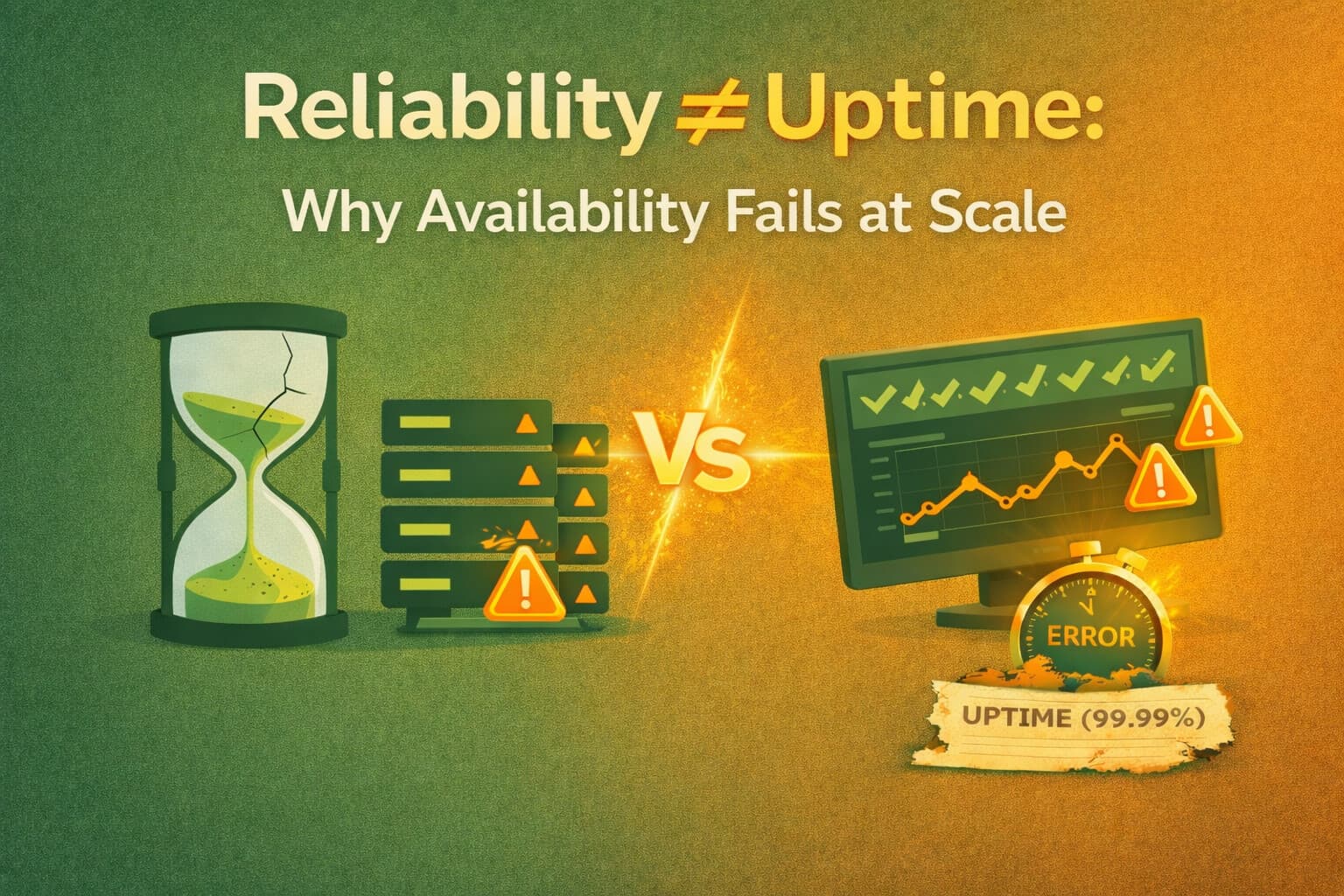
Understanding why uptime fails at scale is foundational. Read our guide: Reliability ≠ Uptime: Why Availability Fails at Scale .
2) Error Budgets: Convert reliability into decisions
Once an SLO exists, it creates an error budget.
- If your SLO is "99.9% success," your allowed failure rate is 0.1%.
- The budget is your permission to change.
This is where SRE becomes real.
Because now you can say:
- "We can ship faster because we're within budget."
- "We need a feature freeze because we're burning budget too fast."
- "We can take on a risky migration only if we add guardrails."
Burn rates: urgency, not vibes
A raw error rate isn't enough. You need burn rate:
- Burn rate = (current failure rate) / (allowed failure rate)
Example:
- SLO allows 0.1% failure
- current failures are 1.0%
- burn rate = 1.0 / 0.1 = 10×
Meaning: you'll burn a 30-day budget in ~3 days.
That's how you turn "something feels off" into clear action.
Recommended Reading
Learn how error budgets help scale teams without burnout: Error Budgets for Scaling Teams: How to Grow Without Burning Out On-call .
3) Incidents: Run production failure as a managed process
Incidents are inevitable at scale. What matters is:
- how fast you detect,
- how well you contain,
- how quickly you recover,
- and whether you learn in a way that prevents repeats.
A practical incident response model needs:
Clear definitions
- What counts as an incident?
- What severity levels exist?
- What triggers escalation?
Roles (even if the team is small)
- Incident Commander (keeps coordination tight)
- Ops lead / Triage lead
- Comms (internal + customer-facing, if needed)
- Subject matter owners (DB, backend, infra)
A bias toward containment
The best incident move is often:
- reduce blast radius,
- degrade gracefully,
- protect the critical flow,
- stop retry amplification,
- shed load safely.
Not "debug forever while the system melts."
4) Postmortems: Make incidents pay rent
If incidents keep repeating, your postmortems are failing.
A postmortem is not:
- a blame ritual,
- a timeline document,
- a "we'll do better" meeting.
A postmortem should produce:
- the failure mode
- the contributing conditions
- the detection gap
- the containment gap
- the recovery gap
- the change that prevents recurrence
A simple structure that works:
- What users experienced (impact on the primary flow)
- What the system did (symptoms + evidence)
- What failed first (root failure mode)
- Why it became user-visible (amplifiers: retries, saturation, queueing, hotspots)
- What we're changing (ranked by ROI + risk)
- What we're instrumenting (so we see it earlier next time)
Key SRE principle: Postmortems must change the system, not just the document.
5) Change: Reliability improvements must ship (with guardrails)
The loop ends where most teams stop: implementation.
A reliability program that never changes production is just governance theater.
Changes that reliably reduce incidents tend to be in these buckets:
A) Failure containment patterns
- timeouts (explicit, per dependency)
- retries only when safe + jitter + caps
- circuit breakers
- bulkheads (isolation)
- load shedding / backpressure
Recommended Reading
Learn the essential resilience patterns: Designing for Failure: Timeouts, Retries, Circuit Breakers, and Bulkheads .
B) Risk-controlled delivery
- progressive rollouts (canary)
- feature flags
- fast rollback
- release markers that correlate deploys to regressions
- SLO-based alerting that triggers before customers do
C) Capacity + saturation control
- pool sizing (threads, DB connections)
- queue limits and timeouts
- DB contention reduction (locks/hot keys)
- headroom targets
"Fake SRE" anti-patterns (how SRE fails in the real world)
If your team says "we're doing SRE" but incidents don't go down, you're likely here:
Anti-pattern 1: SRE = monitoring
Dashboards do not create reliability. They detect pain you already have.
If your SRE work is "add more alerts," your on-call will drown.
Anti-pattern 2: SRE = ticket queue
If SRE becomes the team that "fixes production for everyone," you create: dependency, slow delivery, and zero ownership upstream.
Anti-pattern 3: SLOs exist, but nothing is governed
If error budgets don't change decisions, SLOs are just numbers.
Anti-pattern 4: Measuring uptime while users fail
Partial outages, tail latency, and degraded flows are how real incidents show up.
Anti-pattern 5: Postmortems produce no change
If the same class of incident happens twice, you didn't learn. You documented.
Anti-pattern 6: Tool-first reliability
Buying tooling feels like progress. But reliability comes from controlled change + failure mode removal.
A practical "SRE consulting" engagement (what it looks like when it's real)
If you're looking for SRE consulting that ships, the outputs should be tangible:
- 1–3 flow-level SLIs defined and instrumented
- first-pass SLOs + error budget policy
- burn-rate alerting (high signal)
- incident workflow + roles + runbooks for top scenarios
- a postmortem loop that produces ranked action items
- a reliability backlog (quick wins + structural fixes)
- rollout guardrails (canary/rollback triggers)
Not a deck.
30-day SRE bootstrapping plan (minimal, effective)
Week 1: Define what matters
- pick critical flows
- implement flow-level measurement (success + P95/P99)
- remove metric noise that hides reality
Week 2: Set SLOs + budgets
- define 1–3 SLOs
- set error budgets + burn rate thresholds
- align alerting to user outcomes
Week 3: Make incidents executable
- define severities + escalation
- create 3–5 runbooks (the incidents you actually get)
- ensure rollback is fast and tested
Week 4: Close the loop with change
- run postmortems on recent incidents
- ship the top 3 recurrence reducers
- implement rollout guardrails
If your system is "mostly up" but still unreliable in the flows that matter, we can help you implement SRE as an operating loop — not a slide deck.
FAQ
Questions readers usually ask next
What is the SRE control loop?
The SRE control loop is: SLI/SLO → Error Budget → Incident → Postmortem → Change. SLIs define reliability as user outcomes (not uptime). Error budgets convert reliability into decisions. Incidents are run as a managed process. Postmortems must produce changes that prevent recurrence. Change ships with guardrails. If any part is missing, you get 'SRE theater'—lots of activity, not much reliability.
What are SLIs and SLOs?
SLIs (Service Level Indicators) measure whether users successfully complete what matters—like checkout success rate or P95/P99 latency for critical flows. SLOs (Service Level Objectives) define 'How reliable is reliable enough?'—for example, '99.9% of checkout attempts succeed over 30 days.' SLOs are policy inputs, not vanity goals.
What is a burn rate?
Burn rate = (current failure rate) / (allowed failure rate). If your SLO allows 0.1% failure but current failures are 1.0%, your burn rate is 10×—meaning you'll burn a 30-day budget in ~3 days. Burn rates tell you urgency: 'we're fine,' 'we're drifting,' or 'we're going to have an incident today if nothing changes.'
What are common 'Fake SRE' anti-patterns?
Common anti-patterns include: SRE = monitoring (dashboards don't create reliability), SRE = ticket queue (creates dependency and slow delivery), SLOs exist but nothing is governed (error budgets don't change decisions), measuring uptime while users fail (partial outages are how real incidents show up), postmortems produce no change (same incidents repeat), and tool-first reliability (buying tools feels like progress but doesn't create reliability).
The Loop
Each part of the loop feeds into the next. Missing any part breaks the system.
Real Outputs
Real SRE produces changes in production, not just dashboards and documents.
Ready to Implement SRE?
If incidents repeat and reliability feels unmanaged, you need the control loop. Request a Reliability Audit.
Last updated
February 1, 2026