The core idea
Patterns are tools for constraints. If you can't name the constraint, you're increasing complexity without increasing scalability.
Scalable architecture patterns are not recipes. They are responses to specific constraints that emerge under real load. Most systems fail to scale not because they lack patterns, but because patterns get applied before the bottleneck is understood— or applied to the wrong tier. The result is more complexity, higher cost, and the same tail-latency pain at a larger scale.
This catalog focuses on 12 patterns that repeatedly show up in systems that survive production growth. For each one, the goal is practical: what it actually solves, when to use it, and when it backfires.
Context
Part of the scalable architecture cluster. If you want the full blueprint, start with: Scalable Architecture (Complete Guide) . If you want the constraints behind these patterns, read: Scalable Architecture Principles .
How to use this catalog
Each pattern answers three questions: what constraint does it address, when it helps, and how it fails. If you can't name the constraint, don't ship the pattern. You'll likely create an expensive second system that hides the real bottleneck.
A workflow that actually works
- Baseline tails (P95/P99), saturation (pools/queues/I/O), and dependency behavior.
- Isolate where time and contention accumulate along the critical path.
- Choose the pattern that addresses that specific constraint.
- Validate before/after under representative load or production conditions.
Pattern 1: Stateless services
Constraint it addresses: compute instances become special, scaling creates skew, deploys become risky.
Use it when: always. Stateless compute is the foundation that makes scale-out safe and predictable.
Backfires when: it doesn't, but it can expose the real bottleneck (usually data or coordination), which is the point.
Pattern 2: Scale out (horizontal scaling)
Constraint it addresses: single-node capacity ceilings for parallelizable work.
Use it when: request handling is stateless, jobs are shardable, or reads can be distributed.
Backfires when: state is still inside compute. You get sticky routing, hot nodes, and tail latency that worsens as you add instances.
Pattern 3: Layered caching
Constraint it addresses: repeated reads overload databases and downstream services.
Use it when: read-heavy traffic, expensive queries, semi-stable data, high fanout endpoints.
Backfires when: stampedes, stale data, or opaque cache behavior turns correctness and debugging into chaos.
- Design for miss-storms (stampede protection, jitter, request coalescing).
- Be explicit about freshness and invalidation.
Pattern 4: Read replicas
Constraint it addresses: primary database read saturation.
Use it when: eventual consistency is acceptable and reads dominate cost.
Backfires when: replication lag is ignored and consistency-critical reads accidentally route to replicas.
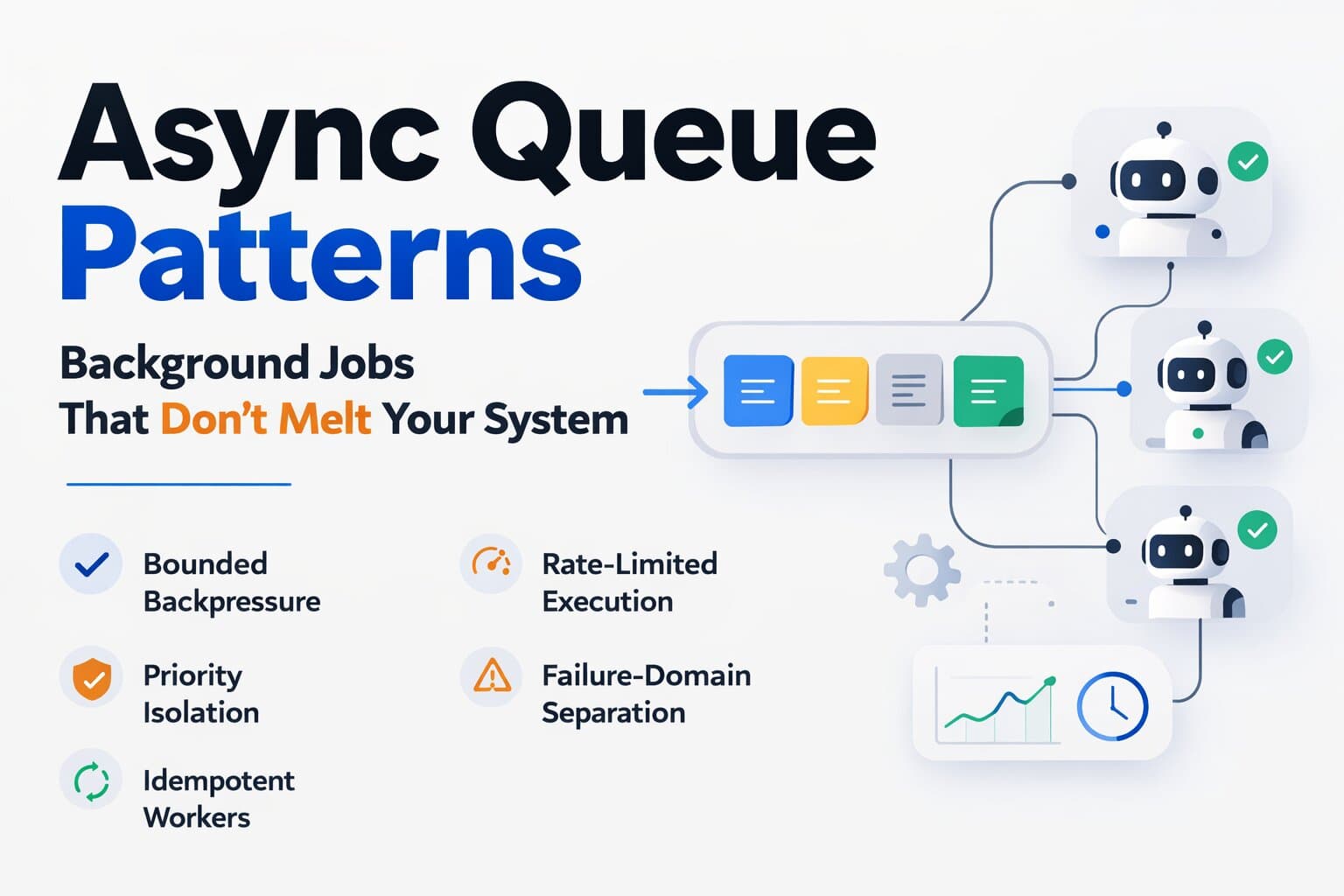
Pattern 5: Async processing with queues
Constraint it addresses: slow or variable work blocks the request path.
Use it when: work is non-critical to the immediate response, long-running, or bursty.
Backfires when: retries are unsafe. Async without idempotency creates duplicate side effects and hidden failure loops.
Pattern 6: Backpressure & rate limiting
Constraint it addresses: unbounded concurrency turns spikes into cascading failure.
Use it when: always—especially before scale-out. Protect pools, queues, and downstream dependencies.
Backfires when: limits are arbitrary or invisible; users experience "random failure" instead of controlled degradation.
Pattern 7: Idempotency keys
Constraint it addresses: retries produce duplicated business effects (double charges, duplicate orders, inconsistent state).
Use it when: any side-effecting API or workflow with retries/timeouts.
Backfires when: idempotency state is stored poorly (hot keys, unbounded growth, weak expiry strategy).
Pattern 8: Circuit breakers
Constraint it addresses: failing/slow dependencies consume upstream capacity and amplify tail latency.
Use it when: remote calls, unreliable dependencies, cross-team or third-party services.
Backfires when: thresholds are mis-tuned; overly aggressive breakers reduce capacity unnecessarily and create self-inflicted outages.
Pattern 9: Bulkheads (resource isolation)
Constraint it addresses: one workload consumes shared resources and starves everything else.
Use it when: multi-tenant systems, mixed criticality traffic, noisy neighbors, background workloads competing with hot paths.
Backfires when: isolation is too granular and causes fragmentation/underutilization; tune based on observed saturation.
Pattern 10: Data partitioning (sharding)
Constraint it addresses: single-node write ceilings and contention at the data layer.
Use it when: writes dominate, datasets are large, and you have a partition key that matches access patterns.
Backfires when: sharded too early without understanding what's hot. You get hot shards, rebalancing pain, and permanent operational complexity.
Pattern 11: Event-driven architecture
Constraint it addresses: tight coupling between producers and consumers; synchronous fanout.
Use it when: independent scaling, asynchronous workflows, cross-team boundaries, high fanout use cases.
Backfires when: used as a default. Debugging, ordering, duplication, and operational visibility become significantly harder without strong observability.
Pattern 12: Graceful degradation
Constraint it addresses: all-or-nothing failure during partial outages.
Use it when: non-core features can fail without blocking the core user journey.
Backfires when: degradation paths are untested and undocumented—then they fail exactly when needed.
How patterns fit together
Scalable systems rarely rely on one pattern. They rely on combinations that control constraints:
- Stateless services + backpressure prevent self-DDoS and make scaling predictable.
- Caching + read replicas protect the primary database and reduce tail variance.
- Queues + idempotency move work off the hot path without creating correctness incidents.
- Circuit breakers + bulkheads limit blast radius during dependency failure.
- Sharding + isolation unlock write scaling once single-node ceilings are real.
The risk is also combinatorial: stacking patterns without a constraint map produces more failure modes than capacity gains. Treat patterns like instruments: choose them because the measurement demands them, not because the architecture diagram looks mature.
What to read next
If you want to apply these patterns safely, the next step is bottleneck isolation and validation. The goal is to prove that a pattern addresses a measured constraint and improves tails under load.
Continue the cluster
Start with the pillar: Scalable Architecture (Complete Guide) , then read: Stateless Services and Caching Patterns .
If you want a repeatable workflow for choosing patterns without guesswork, the next deep dive should be bottleneck isolation and production validation.
Final takeaway
Patterns don't create scalability. They address constraints. The systems that survive growth are not the ones with the most patterns, but the ones that apply the right pattern to the right bottleneck and validate impact under real load.
If you're unsure which pattern will actually move the needle, don't guess. Baseline the system, isolate the constraint end-to-end, then validate improvement in p95/p99 and saturation signals. Get an AI system audit .
Why patterns backfire
Most failures are misapplication: the right tool applied to the wrong tier, without validating impact on tails and saturation.
What to validate
Before/after p95/p99, saturation (pools/queues/I/O), and failure amplification signals (timeouts, retries, breaker trips).
Want a constraint map?
If you're adding patterns but not gaining predictability, start with a baseline audit. We map tail latency drivers, saturation points, and the top constraint end-to-end. Get an AI system audit.
Last updated
January 12, 2026