The core idea
Principles are what remain true when growth changes system behavior. Patterns come and go, but constraints do not.
Scalable architecture is not a moment where you “upgrade to microservices” or “add more servers.” It’s the property of a system that can grow—traffic, data, features, and teams—without a proportional rise in latency, outages, cost, or operational chaos.
Most systems do not fail suddenly. They degrade quietly. Request paths lengthen. Databases become hot. Queues develop backlogs. Tail latency spreads until it becomes the real customer experience. When that happens, teams often reach for patterns—caching, sharding, queues—without asking the harder question: what principle did we violate that made these patterns necessary?
Patterns are tools. Principles are constraints. You can patch a system with tools for a while, but if the constraints are ignored, the architecture will eventually collect interest. It shows up as p99 latency, cascading failures, runaway cloud spend, or “we can’t ship without fear.”
This article is part of the scalable architecture cluster and supports the full pillar: Scalable Architecture (Complete Guide): Patterns, Principles, Design & Examples . If you want the full blueprint and reference architecture, start there.
Why principles matter more than patterns
If you’ve ever watched an architecture “work fine” for months and then become fragile as growth accelerates, you’ve seen a simple truth: scalability problems are rarely new problems. They are old assumptions becoming false.
Principles help because they describe what remains true when load changes the behavior of the system. They keep you from designing for the happy path while ignoring the physics of contention, variance, and failure.
The nine principles below are not opinionated style guidelines. They are repeated constraints that show up across scalable architectures in production, regardless of stack or cloud provider.
Principle 1: Prefer stateless compute
Stateless compute is the simplest scalability multiplier because it makes instances replaceable. When an instance is replaceable, autoscaling works, deployments are safer, and recovery is faster. You stop treating your fleet like pets and start treating it like capacity.
Statelessness does not mean “no in-memory optimization.” It means the system does not depend on memory for correctness. Sessions, durable workflow state, and business-critical data should not disappear when one node disappears. If you can kill 20% of your instances and still serve the core experience, you are much closer to a scalable architecture than most teams realize.
Principle 2: Keep the hot path short
Every synchronous dependency adds latency and failure risk. Growth does not just increase request volume; it increases variance. Dependencies that were “usually fine” become unpredictably slow. When your request path is long, that variance accumulates and becomes tail latency.
Scalable architectures protect the hot path—the set of actions that represent most traffic or most revenue. They keep it dependency-light, predictable, and resilient to partial failure. When non-critical work exists, it moves off the request path. If your request needs more dependencies than you can list from memory, your hot path is already too long.
Principle 3: Control concurrency everywhere
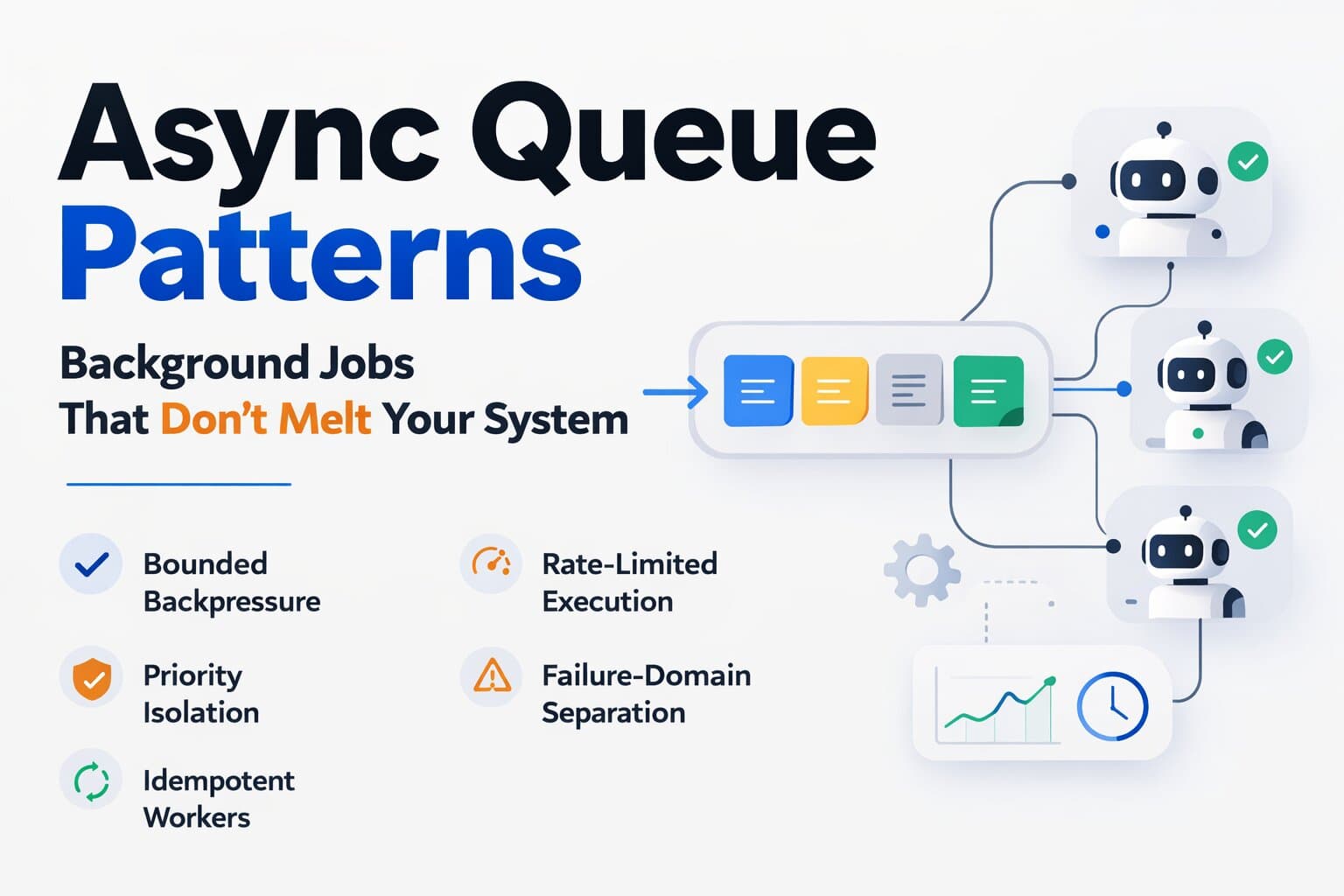
Many systems don’t die because traffic is high. They die because concurrency is unbounded. Unlimited fan-in is how a system DDoSes itself: thread pools drain, database pools saturate, queues explode, and the failure turns into a retry storm.
Controlling concurrency is not a performance tweak. It is a stability feature. It turns overload from “catastrophe” into “degradation with boundaries.” The healthiest systems have deliberate limits across requests, workers, pools, and downstream calls, because they assume spikes and they refuse to let spikes become cascading failures.
Principle 4: Build backpressure, not just autoscaling
Autoscaling is reactive. Backpressure is protective. Autoscaling has a delay and cannot rescue you from sudden spikes, dependency slowness, or contention explosions. Backpressure, on the other hand, is the system’s ability to say “no” in a controlled way before overload turns into collapse.
Backpressure can take many forms—bounded queues, admission control, circuit breakers, degraded responses— but the goal is always the same: preserve core functionality by shedding non-critical work and protecting the parts of the system that must remain healthy. Without backpressure, scaling tends to fail dramatically, not gradually.
Principle 5: Make retries safe with idempotency
In a large system, retries are not optional. They are inevitable. Networks fail, nodes restart, dependencies hiccup, and clients retry. If your system treats retries as rare edge cases, growth will eventually turn that assumption into a correctness incident.
Idempotency is the architecture principle that turns retries into a safe behavior. It means repeating an operation does not produce duplicated business effects. Without idempotency, retries produce double charges, duplicate orders, inconsistent state, and subtle “ghost side effects.” With idempotency, retries become a reliability tool rather than a correctness liability.
Principle 6: Scale data intentionally
Most scalability failures are data failures. Compute is rarely the long-term bottleneck. Data is. Reads scale earlier and more easily through caching, replication, and precomputation. Writes scale later and more painfully because they collide with contention, coordination, and consistency requirements.
Scalable architectures treat read scaling as a first-class design effort. They use layered caching, read replicas, materialized models, and indexes so the primary data store is protected. When write scaling becomes the constraint, the approach shifts: reduce contention, avoid hot keys, batch where possible, and partition deliberately when a single node cannot keep up. The biggest mistake is “shard early” without understanding what is actually hot.
Principle 7: Avoid global coordination
Any design that requires global agreement across the system will eventually become a bottleneck. Global coordination often hides behind normal-looking features: global counters, centralized locks used as a default tool, single-leader writes, and synchronous fanout.
Scalable systems reduce coordination wherever correctness allows. They use partitioned ownership, tolerate eventual consistency where appropriate, and avoid global choke points that force unrelated work to wait on the same shared resource. If a single tenant, user, or product can dominate a key or lock, your architecture has a scalability time bomb—whether traffic is “high” or not.
Principle 8: Assume failure, plan degradation
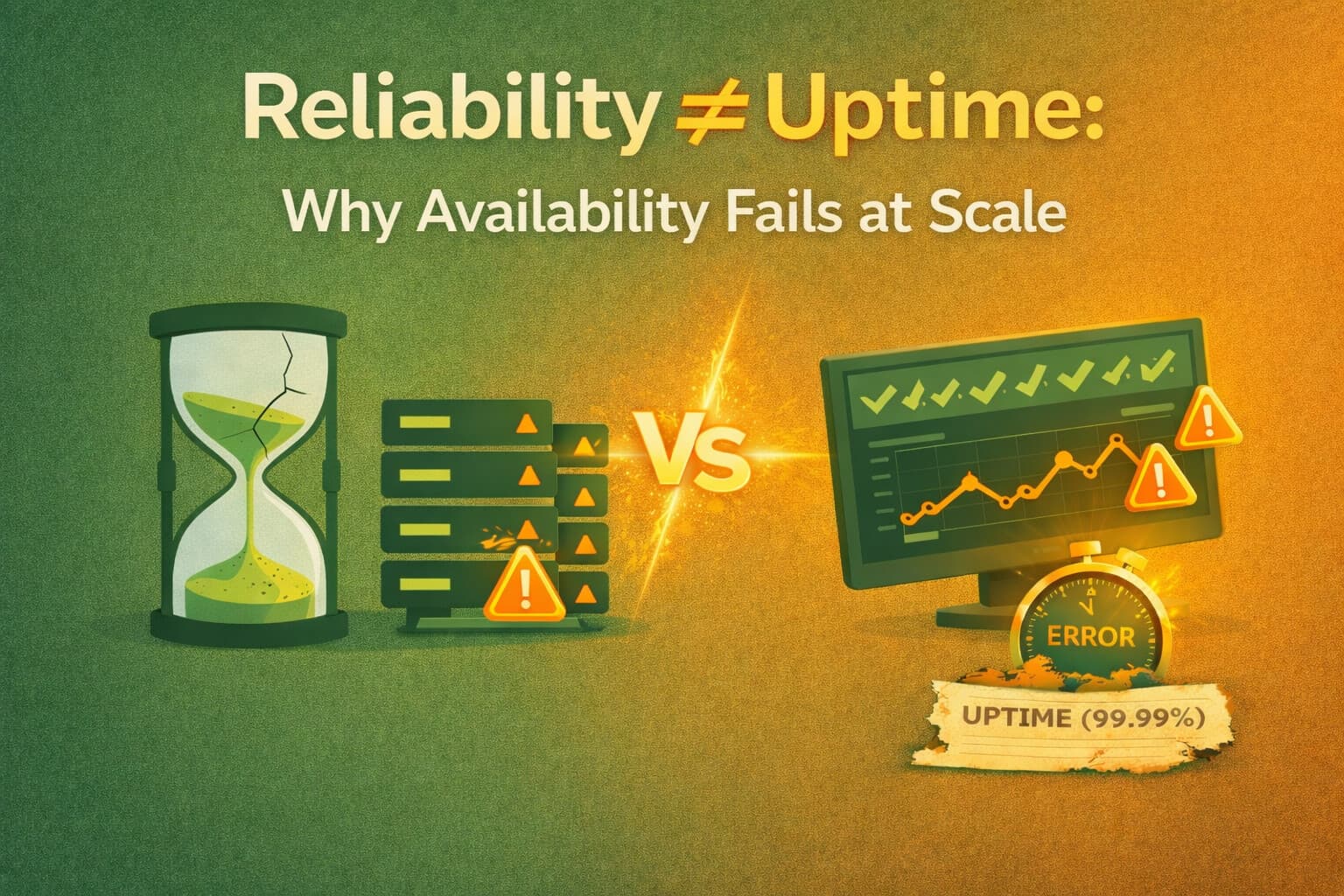
Scalability and reliability are inseparable. As load grows, small failure rates become constant operational pain. Dependencies become slow. Networks become inconsistent. At scale, “rare” becomes “daily.”
Scalable architectures plan for this. They define timeouts for every network call. They retry only when safe, and only with backoff and jitter. They isolate resource pools so one dependency cannot consume the entire system. And they degrade gracefully, meaning the system continues to deliver core value even when secondary capabilities fail. Resilience is not an emergency plan; it is part of scaling.
Principle 9: Optimize for operability
A system can scale traffic and still fail to scale the organization. That failure looks like slow releases, hero-driven operations, and constant debugging. The architecture becomes a mystery, and growth becomes fear.
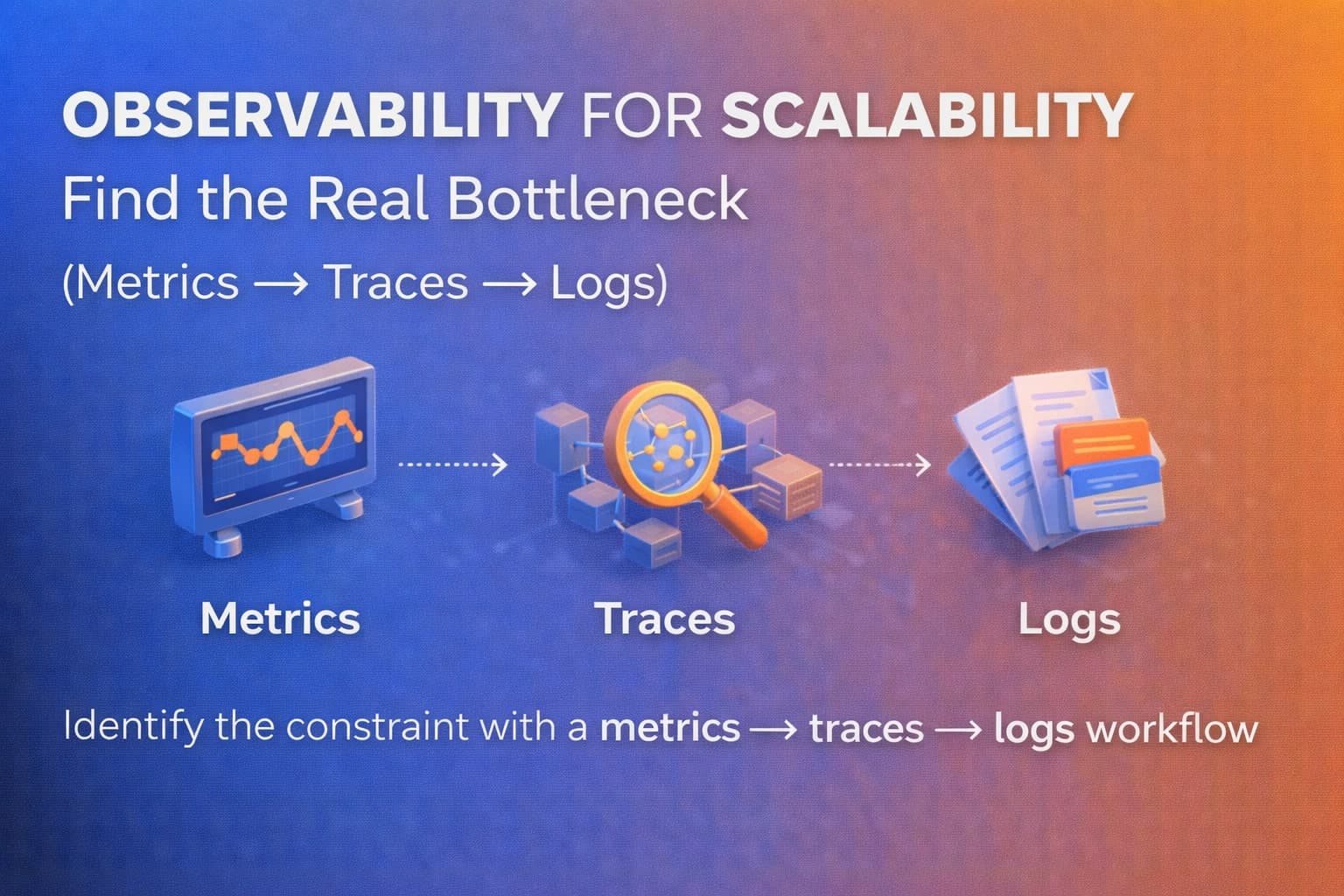
Operability is an architectural property. Scalable architectures are designed to be observed and understood under pressure. They have production tracing, dashboards aligned to user journeys, clear ownership boundaries, and runbooks that reflect real failure modes. The simplest rule is this: if you can’t debug it quickly, you can’t scale it. You can only increase incident rate while guessing.
What these principles look like in real systems
When teams apply these principles, they stop “pattern shopping” and start designing for constraints. Stateless services unlock safe scaling. Short hot paths reduce tail latency amplification. Concurrency limits and backpressure prevent spikes from becoming incidents. Idempotency turns retries from chaos into safety. Intentional data scaling prevents the database from becoming a permanent choke point. Reduced coordination keeps work independent. Planned degradation prevents failures from cascading. Operability turns the whole system into something humans can run.
The theme is not that scalable systems avoid complexity. It’s that they control complexity. They accept that growth increases variance, and they design for the world that exists under load—not the world that exists in a demo.
What to read next
If you want to translate these principles into concrete architecture decisions, the most useful next steps are: the patterns catalog, the data scaling deep dive, and the “traps” article that explains how scalable architectures still collapse when constraints go unseen.
Continue the cluster
Start with the full guide: Scalable Architecture (Complete Guide) , then go deeper with: Architecture Scalability: What Actually Breaks First and Scalability vs Performance vs Reliability .
If you’re seeing p99 creep, saturation spikes, or “random slowness,” principles become visible through measurement.
Final takeaway
Scalable architecture is not a collection of fashionable patterns. It is the result of consistently applying constraints that remain true under load. The systems that survive real growth do not rely on optimism. They rely on boundaries: short hot paths, controlled concurrency, safe failure, and operational clarity.
If your system looks stable in dashboards but feels slower to users, you may already be violating one of these principles. The fastest way to find out is not to debate architecture. It is to baseline the system, isolate the constraint end-to-end, and validate improvement under real conditions.
If you want help doing that, we offer a 7-day Baseline Audit that maps tail latency drivers, saturation points, and the top bottleneck—without guesswork. Get an AI system audit .
FAQ
Questions readers usually ask next
What are scalable architecture principles?
Scalable architecture principles are constraints that remain true when growth changes system behavior. They include: prefer stateless compute, keep the hot path short, control concurrency everywhere, build backpressure (not just autoscaling), make retries safe with idempotency, scale data intentionally, avoid global coordination, assume failure and plan degradation, and optimize for operability.
What's the difference between scalability principles and patterns?
Principles are constraints that remain true regardless of implementation. Patterns are tools that implement principles. For example, 'prefer stateless compute' is a principle, while 'stateless services' is a pattern. Principles tell you what to optimize for; patterns tell you how to implement it. If you apply patterns without understanding principles, you'll create complexity without scalability.
Why do scalability failures usually happen at constraints, not capacity?
Most systems don't fail because they run out of servers. They fail because shared resources saturate: connection pools exhaust, queues back up, locks contend, dependencies amplify tail latency, and retries multiply load. These constraints show up as tail latency, incident rate, and unpredictable behavior—not just higher CPU. The fastest path to scalability is identifying and removing constraints, not adding capacity.
How do I know if my architecture violates scalable principles?
Signs include: tail latency (P95/P99) worsens faster than load increases, pools/queues saturate before CPU maxes out, failures cascade across service boundaries, deploys are risky or require special handling, scaling doesn't improve predictability, and the system becomes harder to debug under load. If you can't kill instances, deploy safely, or scale predictably, you likely have hidden state, uncontrolled concurrency, or missing backpressure.
What breaks first at scale
Not "capacity." Usually it's variance: contention, saturation, long dependency chains, and unpredictable tail latency.
What survives real load
Short hot paths, bounded concurrency, safe retries, intentional data scaling, and systems built to be operated by humans.
Want a constraint map?
If your architecture is "scalable on paper" but unpredictable in production, a baseline audit can reveal the real constraint end-to-end. Get an AI system audit.
Last updated
January 6, 2026