The core idea
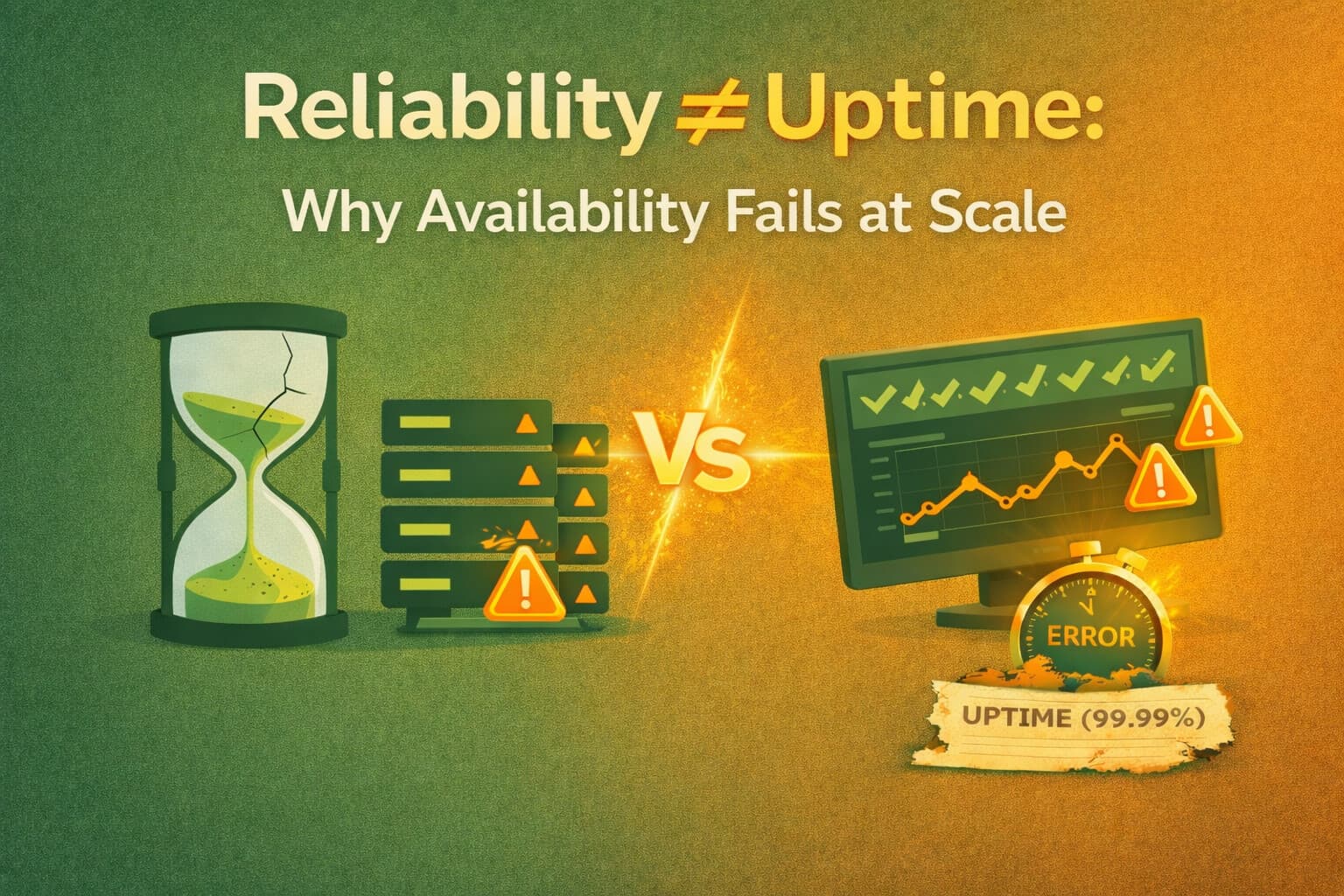
At 10× traffic, the first failures are usually constraints: long hot paths, pool exhaustion, hotspots, retry loops, and weak operability.
Most teams think scalability breaks when a system runs out of servers. That's rarely what happens. What breaks first is almost always constraints: pooled resources, hidden coordination, dependency amplification, and data hotspots that stay quiet until growth forces them into the open.
That's why "10× traffic" is so misleading as a planning exercise. It sounds like a capacity problem. In reality, it's a behavior problem. Growth changes the shape of your workload, the way your dependencies fail, and the way contention emerges in shared resources. The system you had at 1× is not the system you have at 10×.
This article is a reality check. It explains what usually breaks first when load multiplies, why these failures show up as tail latency and incident rate (not just higher CPU), and what architectural signals you can use to catch them early.
Context
Part of the scalable architecture cluster. If you want the full blueprint, start with: Scalable Architecture (Complete Guide) . For the foundations behind the patterns, see: Scalable Architecture Principles .
The myth: scaling breaks when you "run out of servers"
Servers are the most visible part of a system, so they get blamed first. But scalable architectures rarely fail because a CPU chart goes red. They fail because a shared resource saturates, and saturation creates feedback loops: queues form, latency rises, retries multiply load, and more work piles onto the hottest components.
The painful part is that this failure mode often starts while dashboards look "fine." Average latency stays stable. CPU stays below 60%. The system feels normal—until it doesn't. Then you get the classic incident timeline: user complaints, timeouts, high error rate, and the feeling that the system is unpredictable.
If you want to design for architecture scalability, you need to stop asking "how many servers will we need?" and start asking "which constraint will saturate first, and what will it do to tail latency?"
What "10× traffic" really means
A 10× increase is rarely uniform. It's not ten times the same workload. It's burstier traffic, more uneven distribution across tenants and endpoints, deeper request paths, and higher variance in dependencies. A system that was stable under steady load can become fragile under bursts, even if average throughput still looks manageable.
In practice, growth creates two changes that matter more than raw volume. First, it increases contention, because shared resources become hot. Second, it increases variance, which expands tail latency. That tail latency becomes user experience, and user experience becomes product risk.
Failure #1: the hot path gets longer (and the tail explodes)
At 1× traffic, a request path can afford to be "a little too chatty." Dependencies are mostly healthy, and latency variance is low. At 10×, that same request path amplifies everything: one slow dependency spreads across the entire flow, one additional synchronous hop becomes a tail-latency multiplier, and one "minor" remote call becomes the reason p99 drifts upward every week.
This is one of the earliest breaks in architecture scalability because it is structural. The more your hot path depends on other systems, the more you inherit their failure modes. Most teams discover this when an internal service becomes slow, and suddenly the "core" product feels unreliable.
The architecture response is not "optimize the slow dependency." It's to shorten the hot path, move non-critical work off the request path, and make the core experience resilient to partial failure.
Failure #2: pools exhaust and latency turns into timeouts
Resource pools are silent constraints. Connection pools, thread pools, worker pools, and I/O queues can all saturate under bursts. When they saturate, the system doesn't just slow down. It starts timing out, because waiting becomes unbounded. That transition—from "slow" to "timeouts"—is where incident rate spikes.
Most engineers don't notice pool exhaustion early because CPU can still look fine. Saturation is not "high usage." Saturation is "no capacity left to absorb variance." Under growth, variance is guaranteed. So a pool that was safe at 1× becomes dangerous at 10×, even if average usage appears reasonable.
Architecture scalability requires deliberate concurrency control and admission control. The goal is to avoid turning overload into a cascading failure by forcing bounded behavior.
Failure #3: data hotspots and lock contention take over
Most architectures scale compute before they scale data, and that works until the database becomes the bottleneck. At 10×, data systems become hot in non-obvious ways: a single index becomes the dominant cost, one query pattern grows disproportionately, and one "global" table turns into a contention point.
Even more dangerous are hotspots caused by skew. One user, tenant, or product can dominate load. The architecture can look scalable in general but fail in the presence of uneven distribution. This is one of the reasons global counters, global locks, and centralized coordination are so expensive at scale: they turn skew into saturation.
When the database becomes hot, teams often respond with replicas and caching. Those patterns help, but the deeper work is to address contention, reduce coordination, and partition intentionally when a single node cannot keep up with writes.
Failure #4: retries turn into retry storms
Retries are a normal part of distributed systems, but growth changes their math. A retry rate that felt harmless at low volume becomes significant at high volume, and an unreliable dependency can turn into an engine of self-amplifying load.
This is how "small failure rates" become major incidents at scale. Latency rises, clients and services retry, the retry load increases saturation, and saturation makes latency worse. In the middle of an incident, this feedback loop can feel like the system is melting. It's not melting. It's responding to a design that never made retries safe or bounded.
Architecture scalability requires retries to be intentional: safe through idempotency, limited through backoff and jitter, and cut off through circuit breakers when dependencies are unhealthy.
Failure #5: queues become invisible bottlenecks
Queues are one of the best scalability tools, but they are also one of the easiest places to hide problems. At 1×, a queue backlog might recover quickly. At 10×, the backlog becomes persistent, and the system's "eventual" work turns into delayed work that affects customers.
What breaks here is not the queue itself. It's the assumption that asynchronous work is always safe. If worker concurrency is unbounded, or if a downstream dependency is slow, backlogs become a second system with its own incident profile. That incident is harder to see because it doesn't always show up as immediate user-facing latency. It shows up as "emails are delayed," "reports never finish," or "billing is inconsistent."
Architecture scalability requires queues to be treated as production systems with metrics, SLOs, and saturation controls. Otherwise, you have simply moved the bottleneck out of the request path and into a less visible place.
Failure #6: one tenant or key dominates the system
At scale, distribution matters more than averages. Many systems fail because one tenant, one user, or one key becomes dominant. It can be a global counter, a popular product, a "top customer," or a batch job that hits the same partitions repeatedly. The rest of the system looks healthy while one part becomes overloaded.
This is where architecture scalability intersects with fairness and isolation. If a single tenant can starve shared resources, the architecture cannot scale operationally. You eventually end up in a cycle of custom exceptions and per-customer firefighting. Scalable systems treat isolation as a feature: quotas, per-tenant limits, partitioning strategies, and separate queues for noisy workloads.
Failure #7: the system becomes unoperable under pressure
Even if your architecture "should" scale, you lose if it cannot be debugged under load. Many scaling failures feel mysterious because the system lacks visibility: no tracing, weak correlation, unclear ownership, and dashboards that show averages rather than constraints.
Under 10× pressure, the cost of not knowing becomes a direct reliability risk. Teams lose time debating whether the bottleneck is the database or the network or the cache, while the incident continues. The architecture becomes fragile not because it lacks patterns, but because it lacks observability and operational clarity.
In practice, the fastest path to scalability is often the fastest path to understanding: instrument the system, map critical flows, measure saturation, and isolate where time is actually going.
How to spot these constraints before they become incidents
The best scalability work happens before the spike, but it doesn't require guessing. You can spot constraints early by focusing on three classes of signals: tail latency, saturation, and failure amplification.
Tail latency tells you where variance is growing. Saturation tells you where capacity has no room for variance. And failure amplification tells you where dependency behavior can cascade into product behavior. If you baseline these signals and trace the slowest requests, architecture stops being a debate and becomes diagnosis.
If you want a repeatable workflow for that, see the pillar and the supporting deep dives on principles and patterns. The goal is not to "do scalable architecture." The goal is to locate the constraint and design so that constraint cannot collapse the system.
What to read next
If this article feels uncomfortably familiar, you'll benefit most from the principles and patterns deep dives. They translate the failure modes above into repeatable architecture decisions and guardrails. Start with the principles, then move into the patterns catalog and the data scaling deep dive.
Continue the cluster
Read the full pillar: Scalable Architecture (Complete Guide) , then go deeper with: Scalable Architecture Principles and Scalability vs Performance vs Reliability .
If you want a practical playbook for locating bottlenecks end-to-end, the next article in this cluster will cover isolation workflows and validation under load.
Final takeaway
At 10× traffic, systems rarely collapse because you ran out of servers. They collapse because constraints surface, and constraints create feedback loops: longer hot paths amplify tail latency, pools exhaust, data hotspots saturate, retries multiply load, and visibility disappears under pressure.
The most scalable architectures are not the ones with the most patterns. They are the ones that control constraints intentionally. When you design around what breaks first, you stop reacting to growth and start using growth as something the system can survive.
If your system is already showing early signs—p99 creep, saturation spikes, or "random slowness"— the fastest path to clarity is a production baseline and a bottleneck map. Get an AI system audit .
What scaling exposes
Hidden coupling, uneven distribution, and shared-resource saturation. The tail gets worse before the mean moves.
What to watch first
Tail latency, saturation signals (pools, queues, I/O), and dependency amplification. These tell you where scale will break.
Want a bottleneck map?
If growth is making your system feel unpredictable, start with a baseline audit. We map tail latency drivers, saturation points, and the top constraint end-to-end. Get an AI system audit.
Last updated
January 6, 2026